Anytime or Any Time Inroduction:
You’ve probably typed “anytime” in a text, then paused and wondered if it needed a space. Here’s the quick answer: “anytime” is one word when it means “whenever,” and “any time” is two words when you’re talking about an amount of time.
Both are correct English. The trick is knowing which job the phrase is doing in your sentence.
Table of Contents
What “Anytime” Means

Anytime is an adverb. It means “at any time” or “whenever,” and it usually modifies a verb.
- Call me anytime.
- You can leave anytime you want.
Because it functions like a single adverb (similar to “always” or “often”), it gets written as one word.
Read Confusion : Login or Log In
What “Any Time” Means

Any time is a two-word phrase where “time” acts as a noun, and “any” is simply an adjective describing it, the same way it would describe “any money” or “any help.” It refers to an amount or a specific point in time rather than functioning as a standalone adverb.
- I don’t have any time to spare.
- Is there any time this week that works for you?
Here, “time” is the actual subject of the phrase. You could replace it with another noun (“any money,” “any patience”) and the sentence would still make sense.
Which is Correct : Backup or Back Up
Anytime or Any Time: Quick Comparison
| Term | Correct? | Meaning | Typical Use | Example |
| Anytime | Yes | “Whenever,” at any moment | Adverb, replacing “whenever” | “Text me anytime.” |
| Any time | Yes | An unspecified amount or point of time | Noun phrase, often after a preposition or verb like “have” | “I don’t have any time today.” |
Both spellings are grammatically valid. The one that’s “correct” simply depends on what you’re trying to say.
Why People Mix Them Up “Anytime or Any Time”
The confusion happens because “anytime” and “any time” sound identical when spoken. English has several of these pairs “everyday” vs. “every day” is a close cousin where one word functions as a single adverb or adjective, and the two-word version functions as separate parts of speech. Since pronunciation gives no clue, most people default to whichever version they see most often, which is usually “anytime.”
The Simple Test: One Word or Two?
Here’s a fast way to check which form you need.
- Try replacing it with “whenever.” If the sentence still makes sense, use anytime (one word).
- Call me anytime → Call me whenever. ✅ Works, so “anytime” is correct.
- Try replacing it with another noun, like “any money” or “any patience.” If that works, use any time (two words).
- I don’t have any time → I don’t have any patience. ✅ Works, so “any time” is correct.
- Check if a preposition comes right before it. Phrases like “at any time,” “for any time,” or “in any time” almost always keep “time” as a separate noun, so they take the two-word form.
- I haven’t seen him at any time this year.
If none of these feel natural, read the sentence aloud and ask whether you’re describing when something happens (anytime) or how much time something involves (any time).
Correct Spellings : Setup or Set Up
Real-Life Examples “Anytime or Any Time”
Everyday conversation “Anytime or Any Time”
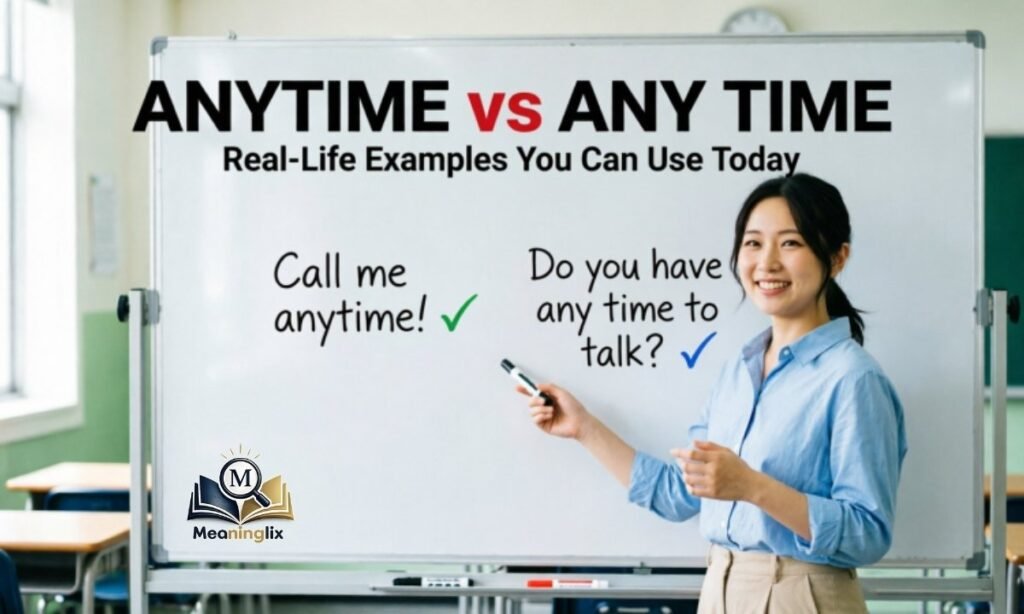
- Correct: “You’re welcome to stop by anytime.”
- Correct: “I didn’t get any time to eat lunch.”
Text messages “Anytime or Any Time”
- Correct: “lol anytime, no worries!”
- Correct: “do u have any time to talk later?”
Workplace communication “Anytime or Any Time”
- Correct: “Feel free to reach out anytime with questions.”
- Correct: “Let me know if you have any time this week for a call.”
Academic or formal writing “Anytime or Any Time”
- Correct: “Students may submit revisions anytime before the deadline.”
- Correct: “The committee did not allocate any time for public comment.”
Common Mistakes to Avoid “Anytime or Any Time”
Mistake: “I don’t have anytime today.” Why it’s wrong: “Time” is functioning as a noun here (the thing you don’t have enough of), so it needs to stand alone as “any time.” Correct version: “I don’t have any time today.”
Mistake: “Feel free to call any time you like, whenever it’s convenient.” This one isn’t technically wrong, but it’s worth noting: “any time you like” and “whenever” both work as adverbial phrases here, so many writers would simplify it to “anytime” for smoother reading.
A simple memory trick: If you can swap in “whenever,” write it as one word. If you can swap in “some time” or “any money,” keep it as two words.
Anytime as an Adjective (Informal Use)
In casual American English, “anytime” sometimes appears as an informal adjective, as in “That’s an anytime kind of offer.” This usage is common in speech and marketing but is generally avoided in formal writing. Stick to the adverb form (“anytime”) or the noun phrase (“any time”) in professional contexts.
American English vs. British English
Both American and British English accept “anytime” as one word in informal writing, though British style guides have traditionally preferred “any time” as two words in all cases, treating “anytime” as a more recent, primarily American convention. If you’re writing for a British audience or a formal publication, “any time” is the safer, more traditional choice even when “whenever” would fit.
Anytime or Any Time: Practical Usage Guidance
When you’re unsure, default to this rule of thumb: if the phrase answers the question “when,” reach for anytime. If it answers the question “how much,” reach for any time.
Most everyday texts, emails, and casual writing lean toward “anytime” simply because people are usually talking about when something can happen, not measuring time itself.
Frequently Asked Questions
Is “anytime” one word or two?
It depends on the sentence. “Anytime” is one word when it means “whenever” and functions as an adverb, as in “Call anytime.” It becomes two words, “any time,” when “time” is used as a noun, as in “I don’t have any time.”
Is “anytime” grammatically correct?
Yes, “anytime” is grammatically correct in American English when used as an adverb meaning “at any time” or “whenever.” It’s widely accepted in both formal and informal writing in the United States.
What is the difference between “anytime” and “any time”?
“Anytime” describes when something can happen and works like the word “whenever.” “Any time” describes an amount of time and works like a noun phrase, similar to “any money” or “any patience.”
Can I always use “anytime” instead of “any time”?
No. You can use “anytime” only when it replaces “whenever.” If “time” is acting as a noun especially after “have,” “spare,” or a preposition like “at” or “for” you need the two-word form, “any time.”
Final Takeaway “Anytime or Any Time”
Both “anytime” and “any time” are correct, and the choice comes down to grammar, not preference. Use anytime as a one-word adverb meaning “whenever.” Use any time as a two-word noun phrase when you’re referring to an amount or point of time.
Run the quick substitution test swap in “whenever” or “any money” and you’ll know exactly which one fits.

Alisha Lehmann is the founder and author of Meaninglix. She specializes in explaining word meanings, internet slang, abbreviations, grammar, and English expressions in simple, accurate language. Her goal is to help readers improve their vocabulary and communicate confidently through clear, well-researched, and easy-to-understand content.
1 thought on “Anytime or Any Time: The Simple Rule You Need 2k26”