You’re typing a text, an email, or a school essay, and you pause on one small word: should it be okay or OK? Both show up everywhere, so it’s easy to assume one must be a typo. Here’s the direct answer: both spellings are correct. “OK” and “okay” are accepted variants of the same word, and the choice mostly comes down to tone and context rather than grammar rules.
Table of Contents
What Does “Okay” (or “OK”) Mean?
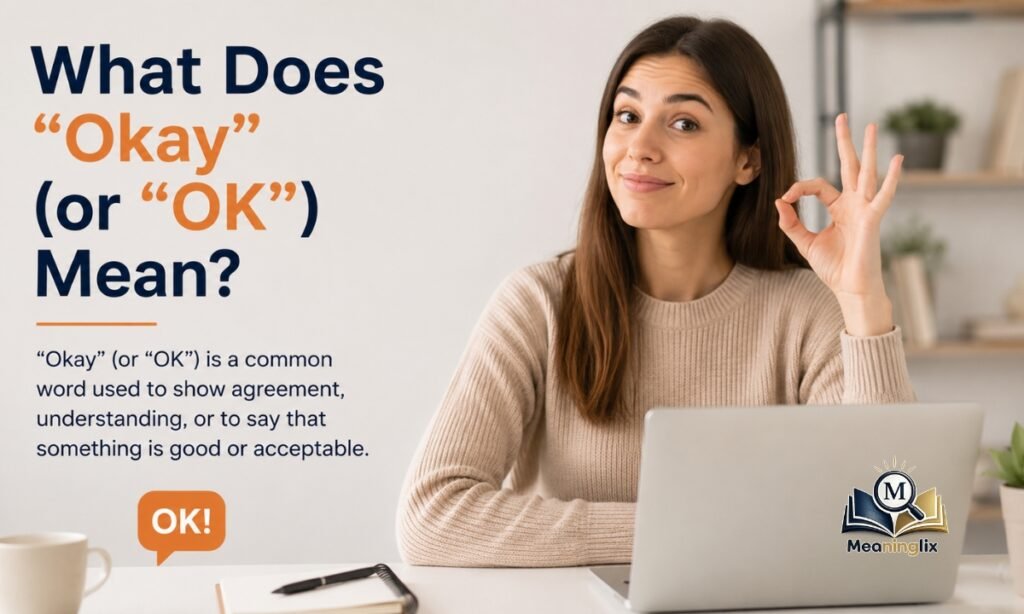
“Okay” is an adjective, adverb, noun, verb, and interjection that signals agreement, approval, or that something is acceptable or satisfactory. You can use it to answer a question (“Is this okay?”), describe a state (“I’m okay”), or simply confirm a plan (“Okay, let’s go”). The meaning doesn’t change based on spelling “OK” and “okay” mean exactly the same thing in every one of these roles.
Click To Read : Anytime or Any Time
Is “OK” Just Short for “Okay”?
Not quite, and this is where a lot of the confusion starts. Many people assume “OK” is an abbreviation of “okay,” but history actually runs the other way. “OK” is generally believed to have come first, tracing back to an 1830s American joke trend of deliberately misspelled abbreviations, where “OK” stood for “oll korrect” (a playful spelling of “all correct”).
“Okay” developed later as a spelled-out version of those same two letters. So instead of “okay” being the original word and “OK” being a shortcut, both forms have been sitting side by side in English for close to two centuries.
Okay or OK: Quick Comparison
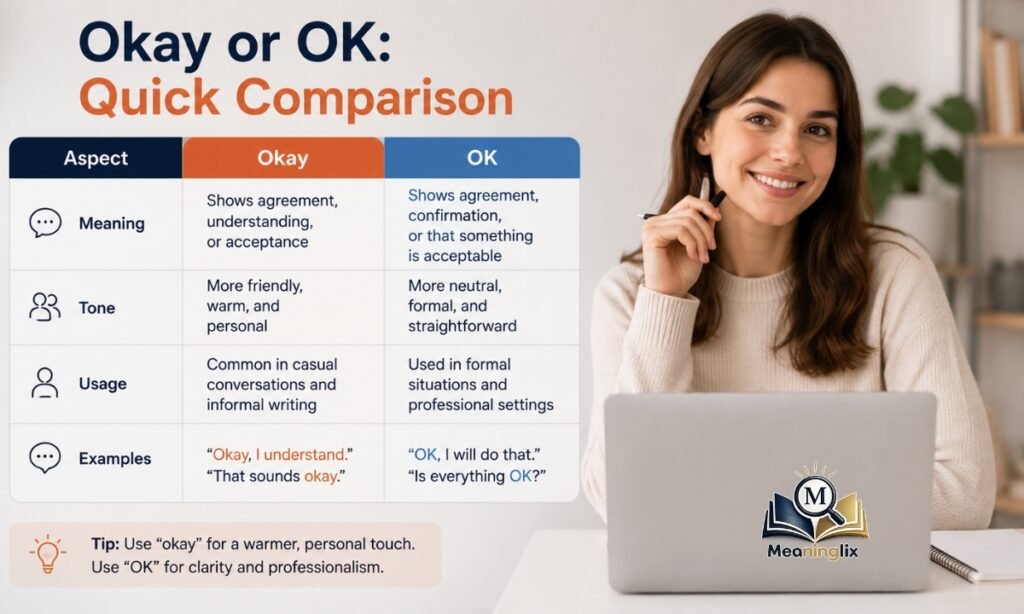
| Term | Correct? | Typical Style | Common Setting | Example |
| OK | Yes | Casual, quick | Texting, notes, headlines | “OK, see you at 6.” |
| Okay | Yes | Slightly more formal-feeling | Essays, emails, dialogue | “That sounds okay to me.” |
| Ok | Informal / inconsistent | Not standard | Casual texting only | “ok sounds good” |
| O.K. | Older style | Rare today | Older print, some style guides | “The deal was O.K.’d by the board.” |
Which Is Correct : Login or Log In
Why People Get Confused About Which One to Use
The mix-up usually happens because both forms are genuinely correct, and readers aren’t used to seeing two spellings of the same word treated as equally valid. Add in autocorrect, which sometimes flips one to the other, plus inconsistent use across texting, social media, and formal writing, and it’s easy to start second-guessing yourself even though you weren’t wrong in the first place.
The Real Difference Between “Okay or OK”
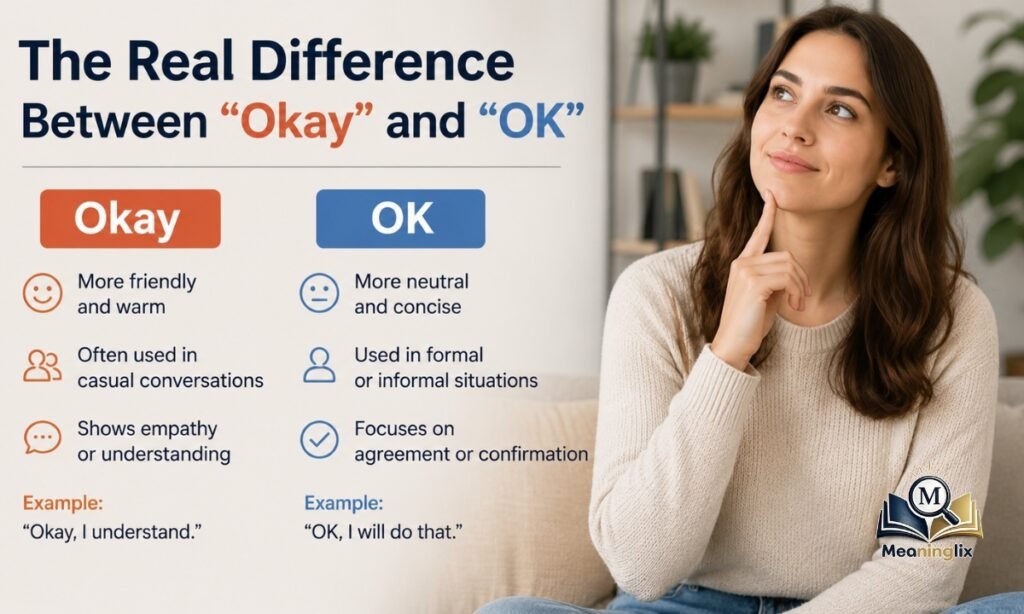
There’s no rule in standard English grammar that makes one form more “correct” than the other. The real difference is stylistic:
- OK tends to feel brisk, modern, and businesslike. It’s common in headlines, texts, and quick replies.
- Okay tends to feel a touch warmer or more conversational, and it reads naturally in dialogue and narrative writing.
Neither one is slang, and neither one is a mistake. The difference is closer to choosing between “email” and “e-mail” than to choosing between a correct and incorrect spelling.
Correct Spelling : Backup or Back Up
Rules for Correct Usage “Okay or OK”
Follow these guidelines to stay consistent and sound polished:
- Pick one spelling and stick with it within a single document, email, or piece of writing. Switching between “OK” and “okay” in the same paragraph looks careless.
- Avoid “ok” with a lowercase K only in formal writing. It’s common in texting, but it isn’t standard in essays, reports, or professional emails.
- Skip the periods (“O.K.”) in modern writing. This older style has mostly fallen out of use outside of some older publications and specific style guides.
- Check your style guide if you’re writing for a publication, employer, or class. Many news organizations and companies specify “OK” as their house style, while some academic guides prefer “okay.”
- Match the tone of your writing. Casual texts and social posts read fine with either form, but a formal report will feel more polished with a spelling you’ve applied consistently throughout.
Real-Life Examples “Okay or OK“
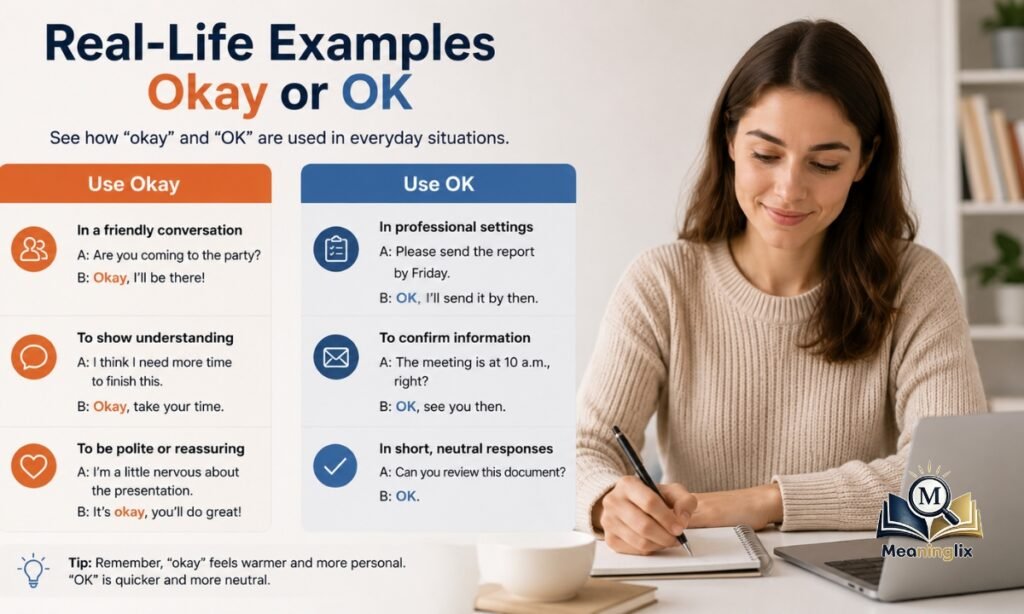
Everyday conversation Correct: “Is it okay if I bring a friend to dinner?” Correct: “OK, that works for me.”
Text messages Correct: “omw, be there in 10, ok?” Correct: “Okay! See you soon.”
Workplace communication Correct: “Let me know if this draft is OK to send.” Correct: “The revised budget looks okay to move forward.”
Academic or formal writing Correct: “The results were considered okay, though not exceptional, by the review committee.” Incorrect: “The results were considered ok by the committee.” Lowercase “ok” without capitalization reads as informal and inconsistent in academic or professional writing.
Social media Correct: “ok but this is actually the best coffee in town” This casual, lowercase style is common online but should be reserved for informal platforms, not formal writing.
Common Mistakes to Avoid “Okay or OK”
Mistake: Writing “ok” with a lowercase K in formal documents. Why it happens: Texting habits carry over into emails and reports without a second thought. Fix: Use “OK” (both letters capitalized) or “Okay” (capitalized only if starting a sentence) in anything formal.
Mistake: Mixing “OK” and “okay” within the same piece of writing. Why it happens: Writers don’t realize both are correct, so they use whichever comes to mind at the moment. Fix: Choose one spelling before you start writing, and search your document afterward to make sure you used it consistently.
Mistake: Assuming “OK” is a lazy abbreviation and “okay” is the “proper” word. Why it happens: People assume all-caps short forms must be shortcuts for a longer word. Fix: Remember that “OK” actually predates “okay” historically, so it isn’t a lesser version of it.
Practical Guidance for Choosing Between Them
If you’re not bound by a specific style guide, here’s a simple approach: use OK for quick, casual, or business-toned communication like texts, chats, and short emails, and use okay when your writing leans more conversational or narrative, such as in dialogue, personal essays, or blog posts.
For anything with an official style guide journalism, a company handbook, an academic paper check the guide first, since it will usually settle the question for you.
Click To Read : Setup or Set Up
Related Terms and Forms “Okay or OK”
- Okey-dokey is an informal, playful variant of “okay,” used mainly in casual speech.
- A-OK an emphatic way of saying something is completely fine, common in spoken English.
- Okayed / OK’d past tense forms used when “okay” functions as a verb, as in “The manager okayed the request” or “The manager OK’d the request.”
FAQs “Okay or OK”
Is “OK” grammatically correct?
Yes. “OK” is a fully standard, grammatically correct form of the word, accepted in both formal and informal writing. It functions the same way “okay” does, as an adjective, adverb, noun, or interjection.
What is the difference between “OK” and “okay”?
There’s no difference in meaning, only in style. “OK” tends to feel quicker and more clipped, while “okay” tends to feel slightly warmer or more conversational. Example: “OK, let’s start” and “Okay, let’s start” mean exactly the same thing.
Should I use “Ok” with only the first letter capitalized?
It’s best to avoid this form in formal writing. Standard style guides recognize “OK” (both letters capitalized) or “okay” (lowercase, capitalized only at the start of a sentence), so “Ok” tends to look like an inconsistency rather than an intentional choice.
Is “OK” British or American English?
Both “OK” and “okay” are used in American and British English. Neither form is regionally exclusive, though some individual style guides on either side of the Atlantic may express a preference for one over the other.
Final Takeaway “Okay or OK”
Both “Okay or OK” are correct, so you don’t need to worry about picking the “wrong” one. What actually matters is consistency: choose the form that fits your tone, follow any style guide you’re working under, and use it the same way throughout your writing.
Get that right, and you’ll never trip over this word again.

Alisha Lehmann is the founder and author of Meaninglix. She specializes in explaining word meanings, internet slang, abbreviations, grammar, and English expressions in simple, accurate language. Her goal is to help readers improve their vocabulary and communicate confidently through clear, well-researched, and easy-to-understand content.
2 thoughts on “Okay or OK: 5 Perfect Rules to Pick the Right Form”