If you’ve typed “infront” and paused, wondering if it looks right, you’re not alone. The correct form is in front, written as two separate words, in standard American English. “Infront” is a common misspelling, not an accepted word in any major dictionary.
This mix-up happens because English lets us glue words together all the time — think “into,” “inside,” or “indoor.” Your brain naturally guesses that “in front” might follow the same pattern, but it doesn’t. Understanding why will help this rule stick for good.
Table of Contents
Quick Answer
In front is the correct spelling. It’s always written as two words, never as “infront.” You’ll use it to describe a position ahead of something or someone, as in “She stood in front of the class.” Dictionaries do not recognize “infront” as a real word.
Which Is Correct: Infront or In Front?
In front is correct. It is a standard prepositional phrase used in every major English dictionary, including Merriam-Webster and Oxford.
Infront is a spelling error. No dictionary lists it as a word, and professional editors, teachers, and style guides all treat it as incorrect. Always write it as two words.
Difference Between Both Words
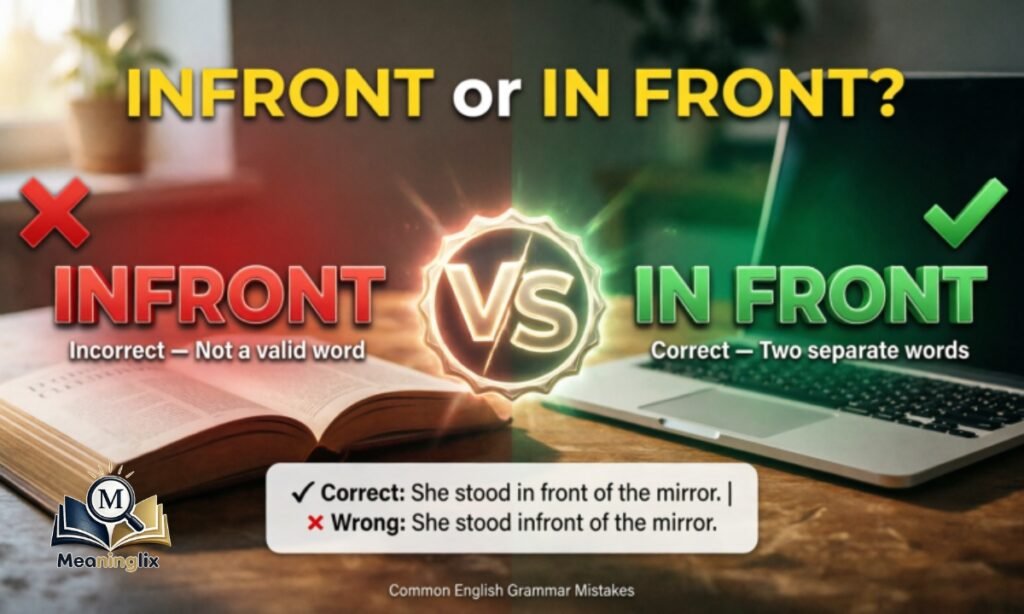
The core issue isn’t really a “difference in meaning” it’s a difference in correctness. In front is the real phrase; infront is simply a misspelling of it. But it helps to see this laid out clearly.
| Word | Meaning | Usage | Example | Correct Situation |
| In front | Positioned ahead of or before something | Standard prepositional phrase (usually with “of”) | “The car stopped in front of the house.” | Always correct in formal and casual writing |
| Infront | Not a recognized word | Misspelling of “in front” | “The car stopped infront of the house.” (incorrect) | Never correct; avoid in all writing |
Read Also : Into or In To
Definitions
In front is a prepositional phrase made of two words: the preposition “in” and the noun “front.” Together, they describe a position that is ahead of, before, or facing something else. It often pairs with “of” to form “in front of.”
Infront has no accepted definition. It’s a spelling mistake that combines two words that were never meant to merge, similar to writing “alot” instead of “a lot.”
When to Use “In Front”
Use in front whenever you want to describe something positioned ahead of, before, or facing another object, person, or place. It almost always appears as “in front of” when followed by a noun.
- She parked her bike in front of the school gate.
- The teacher stood in front of the classroom to begin the lesson.
- A large oak tree grows in front of my grandmother’s house.
- He felt nervous speaking in front of a large crowd.
- The dog waited patiently in front of the door.
When to Use “Infront”
There is no correct context for using infront. It should never appear in essays, emails, resumes, or any professional or academic writing. If you’ve written it, simply add a space between “in” and “front,” and the sentence becomes correct.
Since it isn’t a real word, there are no valid example sentences to show — only the reminder that every instance should be corrected to “in front.”
Side-by-Side Comparison
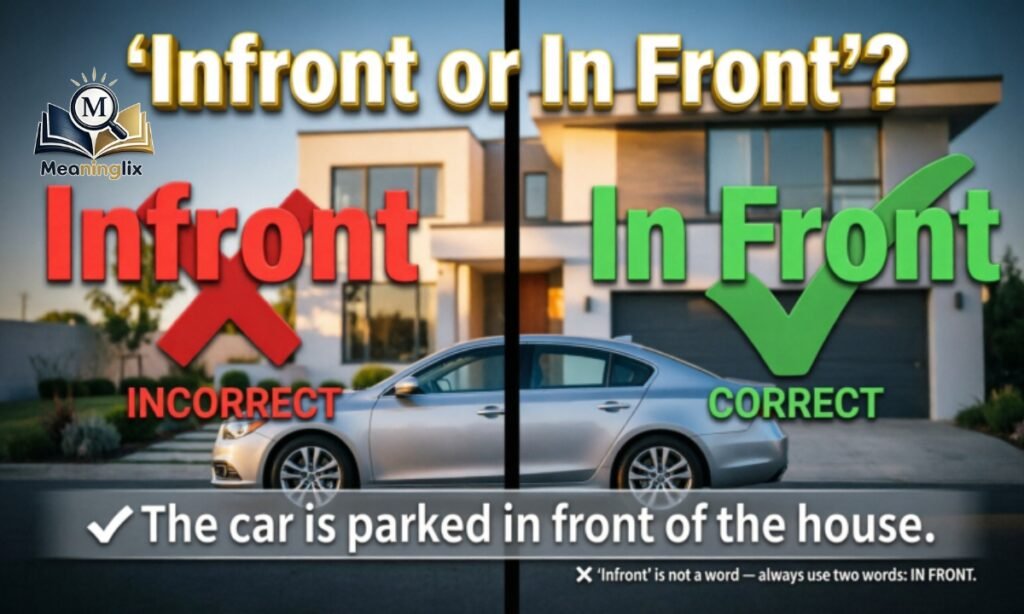
| Feature | In Front | Infront |
| Dictionary status | Recognized standard phrase | Not recognized; considered a spelling error |
| Word count | Two words | One (incorrectly merged) word |
| Grammar function | Prepositional phrase | None; not a valid grammatical unit |
| Common usage | Formal writing, casual speech, academic papers | Informal typing mistakes, texting, quick notes |
| Accepted by style guides | Yes (AP, Chicago, MLA) | No |
| Example | “Stand in front of the mirror.” | “Stand infront of the mirror.” (incorrect) |
Read More : Breath vs Breathe
Common Mistakes
Many learners merge “in front” because English already has similar compound words like “inside,” “indoor,” and “into.” This creates a false pattern that “infront” should also work as one word.
Another common mistake happens with autocorrect. Some phone keyboards don’t flag “infront” as an error, which makes writers assume it’s acceptable when it isn’t.
A third mistake is speed typing. When people type quickly, especially in texts or social media posts, they often skip the space between “in” and “front” without noticing.
Easy Trick to Remember
Think of “in front” like “in the front row.” You wouldn’t write “inthefrontrow” as one word, so you shouldn’t write “infront” either.
A simple memory trick: if you can add “of” after it and it still makes sense, it needs two words. “In front of” works, but “infront of” looks obviously wrong once you see the space missing.
Real-Life Examples
- The photographer asked everyone to stand in front of the fountain.
- A line of customers waited in front of the bakery before it opened.
- My little brother loves sitting in front of the television on Saturday mornings.
- The mayor gave her speech in front of city hall.
- There’s a small garden in front of our apartment building.
- He placed his backpack in front of the door so he wouldn’t forget it.
- The runners lined up in front of the starting line.
- She practiced her presentation in front of the mirror three times.
- A crowd gathered in front of the stage before the concert began.
- The cat sat in front of the fireplace to stay warm.
Common Questions
Is “infront” correct? No. “Infront” is not a correct English word. It’s a misspelling of “in front,” which should always be written as two separate words in any type of writing.
Can I use “infront” instead of “in front”? No, you shouldn’t. Dictionaries, teachers, and professional editors do not accept “infront” as a valid spelling. Using “in front” keeps your writing accurate and professional.
Why do people confuse “infront” and “in front”? People confuse them because English has many compound words like “inside” and “indoor,” which makes “infront” seem like it might follow the same rule. It doesn’t, since “front” always stays separate from “in.”
Similar Grammar Confusions
- Alot vs. A Lot
- Everyday vs. Every Day
- Incase vs. In Case
- Anymore vs. Any More
- Onto vs. On To
Frequently Asked Questions
Is “infront of” ever acceptable in casual texting?
No, even in casual texting, “infront of” is still a spelling mistake. While texting often allows shortcuts and slang, using “in front of” correctly takes no extra effort and keeps your message clear.
Does British English spell it differently?
No. Both American and British English use “in front” as two words. This is one grammar rule that stays consistent across English-speaking countries, unlike words such as “color” versus “colour.”
Why doesn’t autocorrect always catch “infront”?
Some autocorrect systems focus on common misspellings and may not flag “infront” because it resembles other valid compound words. Always proofread your writing instead of relying only on autocorrect.
Is “in front of” formal or informal?
“In front of” works in both formal and informal writing. You can use it in academic essays, business emails, casual conversations, and creative writing without any restrictions.
What part of speech is “in front of”?
“In front of” functions as a compound preposition. It shows the position of one noun in relation to another, such as “the chair is in front of the desk.”
Key Takeaways
- In front is the only correct spelling; infront is always a mistake.
- “In front” functions as a prepositional phrase, often followed by “of.”
- The confusion comes from English compound words like “inside” and “indoor.”
- Autocorrect doesn’t always catch “infront,” so proofreading matters.
- Both American and British English follow the same rule for this phrase.
- A quick trick: if “of” fits naturally after it, keep “in front” as two words.
Conclusion
The rule here is simple and consistent: always write in front, never “infront.” This small detail can make a big difference in how polished and professional your writing looks, whether you’re crafting an email, an essay, or a quick text message.
Once you understand why the confusion happens, spotting and fixing the mistake becomes second nature. Keep the two words separated, remember the “in front of” trick, and you’ll never second-guess this phrase again.

Alisha Lehmann is the founder and author of Meaninglix. She specializes in explaining word meanings, internet slang, abbreviations, grammar, and English expressions in simple, accurate language. Her goal is to help readers improve their vocabulary and communicate confidently through clear, well-researched, and easy-to-understand content.
3 thoughts on “In Front or Infront? The Simple Rule You Need to Know 2026”