
If you’ve typed “devide” and had it underlined in red, you’re not alone. The word sounds like it could start with “de-,” which trips up a lot of writers. Here’s the quick answer: “divide” is the correct spelling.
“Devide” is simply a common misspelling and isn’t recognized in standard American or British English dictionaries.
Table of Contents
The Short Answer
Divide is always the correct spelling, whether you’re using it as a verb (to divide something) or thinking about the related noun (a divide, meaning a gap or split). “Devide” has no valid use in any context it’s a spelling error, not an alternate form or regional variation.
Why People Misspell “Divide” as “Devide”
This mistake usually comes down to sound and habit rather than a real grammar rule. A few things drive it:
- The “de-” prefix is extremely common in English (decide, delay, deny, defend), so writers’ brains default to “de-” even when the word actually starts with “di-.”
- The vowel sound is unstressed. In casual speech, the first syllable of “divide” comes out as a quick “duh” sound, which doesn’t clearly signal whether it’s spelled with an i or an e.
- Autocorrect and fast typing let the error slip through, especially on mobile keyboards where a single wrong letter doesn’t always get flagged.
None of these reasons make “devide” acceptable they just explain why the mistake happens so often.
Click Here To Read : Okay or OK
What “Divide” Means
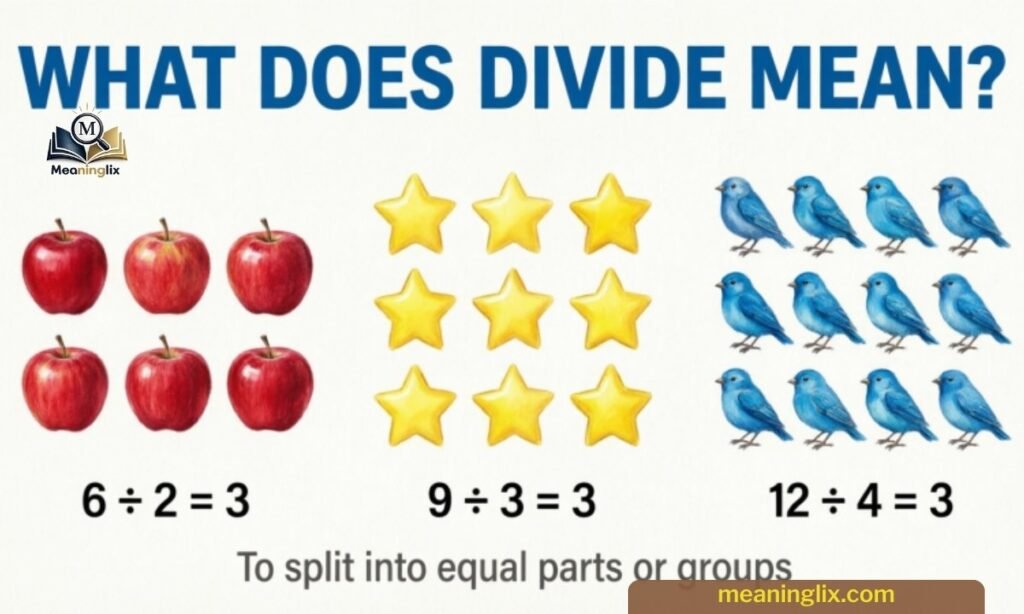
Divide is a verb meaning to separate something into parts, or to perform the mathematical operation of splitting a number into equal shares. It can also function as a noun, referring to a difference or split between groups, ideas, or regions.
- Verb: Divide the pizza into eight slices.
- Noun: There’s a growing divide between the two departments.
Both uses follow the same spelling there’s no version of the word, in any part of speech, that uses “devide.”
Read Compression : Anytime or Any Time
Divide vs. Devide: Quick Comparison
| Term | Correct? | Meaning | Typical Use | Example |
| Divide | Yes | To separate into parts; a split or gap | Math, everyday writing, formal and informal speech | “Divide 20 by 4.” |
| Devide | No | Not a real word | Never correct always a spelling mistake | ~~”Devide 20 by 4.”~~ |
Rules for Using “Divide” Correctly
Once you’ve locked in the spelling, using “divide” correctly is straightforward. Keep these points in mind:
- As a verb, it’s regular: divide, divides, divided, dividing. There’s no irregular past tense to memorize.
- In math, “divide” pairs naturally with “by”: you divide one number by another, not “into” when stating the operation informally (though “divided into” is correct when describing groups).
- As a noun, “the divide” often appears with descriptive words, like generation divide, digital divide, or political divide.
- Divided is the standard past tense and past participle never “devided.”
Real-Life Examples
Everyday conversation
Correct: “Can you divide the bill three ways?” Incorrect: “Can you devide the bill three ways?” The incorrect version misspells the verb entirely, which spell-check will usually catch but it’s worth knowing why it’s wrong.
School or academic writing
Correct: “Divide the fraction by its reciprocal to solve the equation.” Incorrect: “Devide the fraction by its reciprocal to solve the equation.” In academic settings, this kind of error can distract a reader or grader from otherwise correct work.
Workplace communication
Correct: “Let’s divide the project into three phases.” Incorrect: “Let’s devide the project into three phases.” Professional emails and reports are exactly where small spelling slips like this stand out most.
Text messages and social media
Correct: “This topic really divides people lol” Incorrect: “This topic really devides people lol” Even in casual writing, “devide” isn’t an accepted informal spelling it’s just wrong.
Formal writing
Correct: “The committee voted to divide the budget equally among departments.” Incorrect: “The committee voted to devide the budget equally among departments.”
Common Mistakes to Avoid
The core mistake here is simple: writing “devide” instead of “divide.” A few related slip-ups are worth flagging too:
- Mixing it up with “devise.” “Devise” (meaning to plan or invent) does start with “de-,” and it’s likely the reason “devide” feels plausible. Compare: devise a plan vs. divide the work.
- Doubling letters incorrectly, such as “diveide” or “divid,” which are typos rather than intentional spellings.
- Assuming British English uses a different spelling. It doesn’t “divide” is spelled the same way in both American and British English.
A simple way to remember it: think of the word “division.” Since “division” clearly starts with “di-,” the related verb “divide” follows the same pattern.
Practical Tips to Avoid the Mistake
- Say it slowly. Sounding out “di-vide” syllable by syllable can help reinforce the correct spelling in your memory.
- Link it to “division” and “individual.” Both words share the “di-” root, giving you a familiar anchor.
- Turn on spell-check, but don’t rely on it completely some tools autocorrect “devide” to unrelated words instead of “divide.”
- Proofread math and technical writing carefully, since this is where “divide” appears most often and where errors are most noticeable.
Read Now : Login or Log In
Related Words and Forms
A few words built from “divide” follow the same spelling pattern, so getting the root right helps across the board:
- Division (noun) the act of dividing, or a section of an organization
- Divided (adjective/past tense) split into parts, or in disagreement
- Divisible (adjective) capable of being divided evenly
- Divisor (noun) the number by which another number is divided
None of these words use “devi-” either, so learning the correct root spelling clears up the entire word family at once.
Frequently Asked Questions
Is “devide” ever grammatically correct?
No. “Devide” isn’t a recognized word in any English dictionary or grammar reference. It’s always a misspelling of “divide,” regardless of context, tense, or region.
What is the difference between “divide” and “devise”?
Divide means to separate something into parts or perform a mathematical split, as in divide the cake. Devise means to plan, invent, or create something, as in devise a strategy. They’re unrelated words that happen to sound similar in their first syllable.
Is “divide” spelled differently in British English?
No. Divide uses the identical spelling in both American and British English. There’s no regional variation to account for, unlike words such as “color/colour.”
How can I remember the correct spelling for good?
Connect “divide” to “division.” Since most people spell “division” correctly without thinking twice, using it as a mental anchor makes “divide” easier to recall.
The Bottom Line
Between “devide” and “divide,” only one is real: divide. The confusion is understandable given how many English words start with “de-,” but “divide” and every word built from it, like division and divided, always uses “di-.”
Once that root sticks, the spelling mistake tends to disappear for good.

Alisha Lehmann is the founder and author of Meaninglix. She specializes in explaining word meanings, internet slang, abbreviations, grammar, and English expressions in simple, accurate language. Her goal is to help readers improve their vocabulary and communicate confidently through clear, well-researched, and easy-to-understand content.
1 thought on “Devide or Divide? The Correct Spelling Made Easy 2k26”