
If you’ve ever paused mid-sentence wondering whether to write “accept” or “except,” you’re not alone. These two words sound almost identical when spoken quickly, but they mean completely different things. Accept means to agree to receive or take something, while except means to leave something out or exclude it.
This mix-up happens because the words share similar spelling and sound nearly the same out loud. Once you understand the small difference in their letters and the big difference in their meaning, you’ll never confuse them again.
Table of Contents
Quick Answer Accept vs Except
Accept is a verb that means to agree to receive, take, or approve something. Except is usually a preposition that means “excluding” or “other than.” For example: “I accept all the terms except the last one.” The key: accept = to take in, except = to leave out.
Which Is Correct: Accept vs Except?
Both words are correct, but they serve different purposes. Accept is what you do when you say yes to something, like accepting a gift or an apology. Except is what you use when you’re excluding something from a group, like saying everyone came except one person. Neither word replaces the other.
Difference Between Accept vs Except
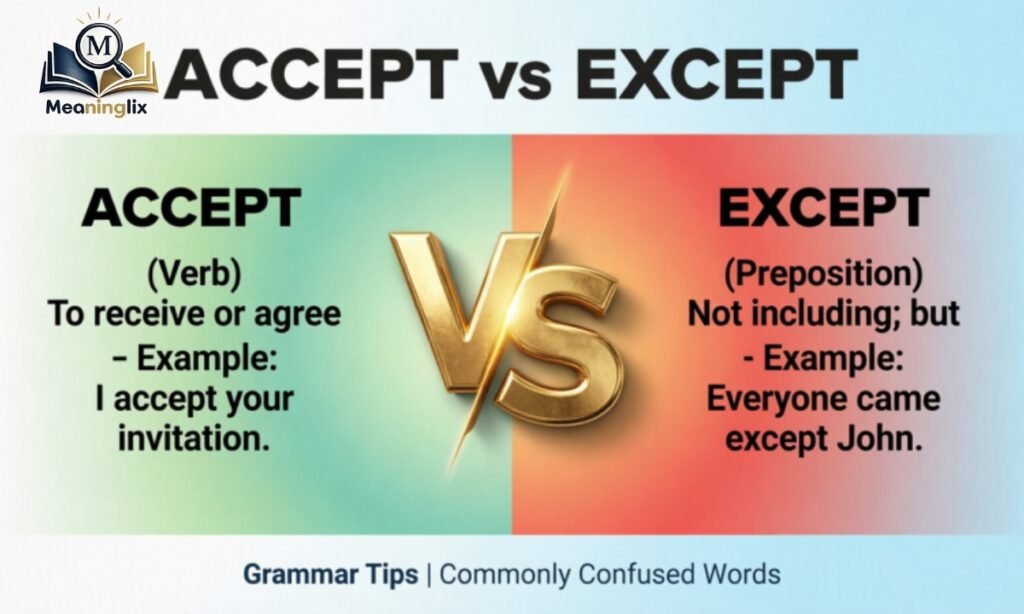
The confusion between accept and except comes down
function. Accept is almost always a verb showing action. Except is usually a preposition or conjunction showing exclusion. Knowing the part of speech instantly tells you which word fits.
| Word | Meaning | Usage | Example | Correct Situation |
| Accept | To agree to receive or take something | Verb | She will accept the award tonight. | Use when someone says yes or receives something |
| Except | To exclude or leave out | Preposition/Conjunction | Everyone left except Tom. | Use when leaving something out of a group |
Definitions Accept vs Except
Accept means to willingly receive, agree to, or approve something offered to you. It shows action and is always used as a verb.
Except means to exclude or leave something out from a larger group. Most often, it works as a preposition, though it can also act as a conjunction or, rarely, a verb meaning “to exclude.”
When to Use Accept
Use accept whenever you’re describing someone agreeing to, receiving, or approving something. It always functions as a verb in a sentence.
- I accept your apology without any hesitation.
- The committee decided to accept the new proposal.
- She couldn’t accept the fact that she had lost the match.
- Please accept this small gift as a token of thanks.
- He was proud to accept the promotion at work.
Notice how accept always involves an action of taking something in or agreeing to it.
Read Now : In Front or Infront
When to Use Except
Use except when you want to exclude something or someone from a general statement. It usually appears as a preposition before a noun or pronoun.
- All the students passed the test except James.
- I like every vegetable except broccoli.
- The store is open every day except Sunday.
- Nobody knew the answer except the teacher.
- We packed everything except the tent.
In each sentence, except points to the one thing left out of the whole.
Side-by-Side Comparison Accept vs Except
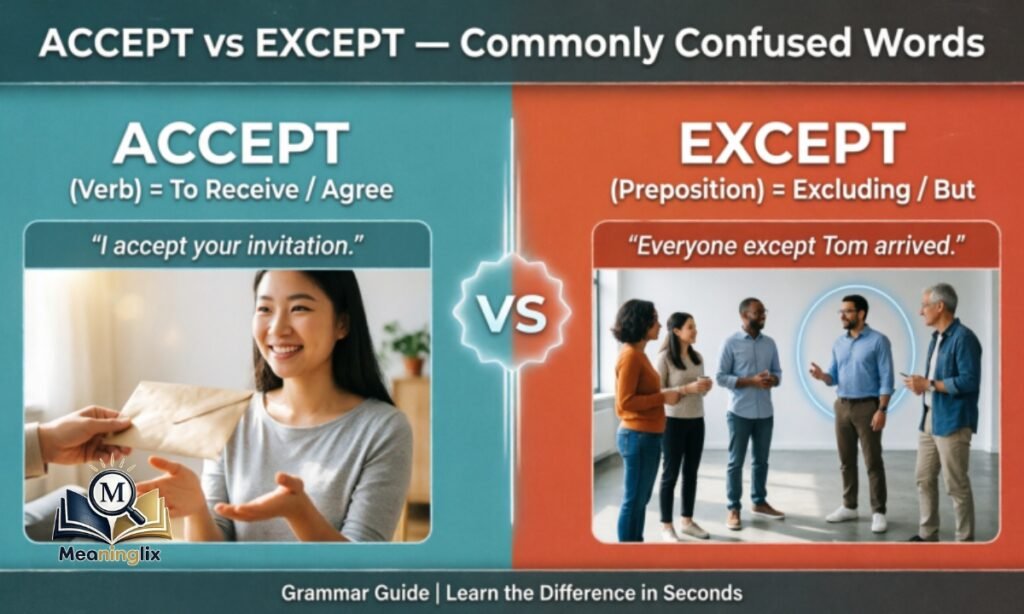
| Feature | Accept | Except |
| Part of speech | Verb | Preposition, conjunction (rarely verb) |
| Core meaning | To receive or agree to | To exclude or leave out |
| Common pairing | Accept + offer, gift, apology | Except + for, when, that |
| Sentence position | Usually follows a subject and precedes an object | Often introduces the excluded item |
| Opposite meaning | Reject | Include |
| Example | I accept your invitation. | Everyone came except Sara. |
Common Mistakes Accept vs Except
Many learners confuse accept and except because they sound similar when spoken aloud. The soft “e” sound at the start blurs together, especially in casual speech.
Another common error happens when writers assume both words relate to agreement. In reality, only accept involves saying yes to something. Except never means agreement; it always signals exclusion.
A third mistake is using “except” when the sentence actually needs “accept,” such as writing “I can’t except this offer” instead of “I can’t accept this offer.” This swap changes the entire meaning of the sentence.
Easy Trick to Remember Accept vs Except
Think of the letter A in accept as standing for Agree. If you’re agreeing to take something, use accept.
For except, remember it often pairs with the word exclude, and both start with EX. If you’re leaving something out, reach for except.
Real-Life Examples Accept vs Except

- The manager will accept your resignation letter tomorrow.
- Every player showed up except the goalkeeper.
- I accept the challenge and I’m ready to start.
- The museum is free to enter except on holidays.
- They didn’t accept my payment because the card expired.
- All flights were canceled except the early morning one.
- She learned to accept criticism as part of growth.
- Nothing surprised him except her sudden apology.
- We accept returns within thirty days of purchase.
- Everyone finished the race except two runners.
Read Also : Into or In To
Common Questions Accept vs Except
Is “except” correct in formal writing?
Yes, except is completely correct in formal writing when used to exclude something from a group or statement, such as in legal, academic, or business documents.
Can I use except instead of accept?
No, except and accept are not interchangeable. Except excludes something, while accept means to receive or agree to something. Swapping them changes the meaning of your sentence.
Why do people confuse accept and except?
People confuse accept and except mainly because of their similar spelling and pronunciation. The words differ by only one letter, which makes it easy to misread or mishear them.
Similar Grammar Confusions
- Affect vs Effect
- Then vs Than
- Its vs It’s
- Complement vs Compliment
- Advice vs Advise
FAQs (Accept vs Except)
What is the simplest way to tell accept and except apart?
Accept always means to receive or agree to something, while except always means to leave something out. If your sentence involves saying yes, use accept. If it involves excluding an item, use except.
Does except ever mean the same as accept?
No, except never means the same as accept. Except signals exclusion, while accept signals agreement or receiving. Confusing the two changes the entire meaning of a sentence.
Can except be used as a verb?
Yes, though rarely, except can function as a verb meaning “to exclude,” as in “Present company excepted.” This usage is uncommon in everyday writing and mostly appears in formal or legal contexts.
Is it correct to say “I except your offer”?
No, this is incorrect. The correct phrase is “I accept your offer,” since accept is the verb used to show agreement or receiving something offered.
How can I avoid mixing up accept and except in writing?
Read your sentence aloud and ask whether you’re including or excluding something. If you mean “yes, I’ll take it,” use accept. If you mean “leaving something out,” use except.
Key Takeaways
- Accept means to agree to receive or take something; it functions as a verb.
- Except means to exclude or leave something out; it usually functions as a preposition.
- The two words differ by only one letter but carry completely different meanings.
- Use the trick “A for Agree” to remember accept, and “EX for Exclude” to remember except.
- Reading your sentence aloud can help you catch which word truly fits.
Conclusion (Accept vs Except)
Accept and except may look nearly identical, but their meanings sit worlds apart. Accept always points toward agreement or receiving something, while except always points toward exclusion. Once you train your eye to notice the single letter that separates them, the confusion disappears for good.
The next time you write a sentence with either word, pause for a second and ask yourself whether you’re including or excluding something. That one habit will keep your writing accurate, clear, and confident every time you reach for accept or except.

Alisha Lehmann is the founder and author of Meaninglix. She specializes in explaining word meanings, internet slang, abbreviations, grammar, and English expressions in simple, accurate language. Her goal is to help readers improve their vocabulary and communicate confidently through clear, well-researched, and easy-to-understand content.
2 thoughts on “Accept vs Except: The Powerful Guide to Never Mix Them Up 2026”