
Into or in to trips up even careful writers because both look almost the same on the page. The short answer is that both are correct, but they work in different situations. Into is one word that shows movement or change, while in to is two separate words that happen to sit next to each other in a sentence.
This mix-up happens because English lets small words like “in” and “to” travel in pairs so often that our eyes start reading them as one unit. Once you learn the simple test behind into or in to, you will stop guessing and start writing with confidence.
Table of Contents
Quick Answer ( Into or In To )
Into is one word used for movement, direction, or transformation, as in “She walked into the room.” In to is two separate words, where “in” is part of a verb phrase and “to” starts an infinitive or connects to another idea, as in “She went in to see the doctor.” Choosing correctly depends on what “in” is doing in the sentence.
Which Is Correct: Into or In To?
Both spellings are correct English, so the question is not which one wins, but which one fits your sentence. Use into when you mean movement toward the inside of something or a change from one state to another. Use in to when “in” belongs to the verb before it and “to” belongs to the phrase after it, usually forming an infinitive like “to see” or “to check.”
Difference Between Into or In To
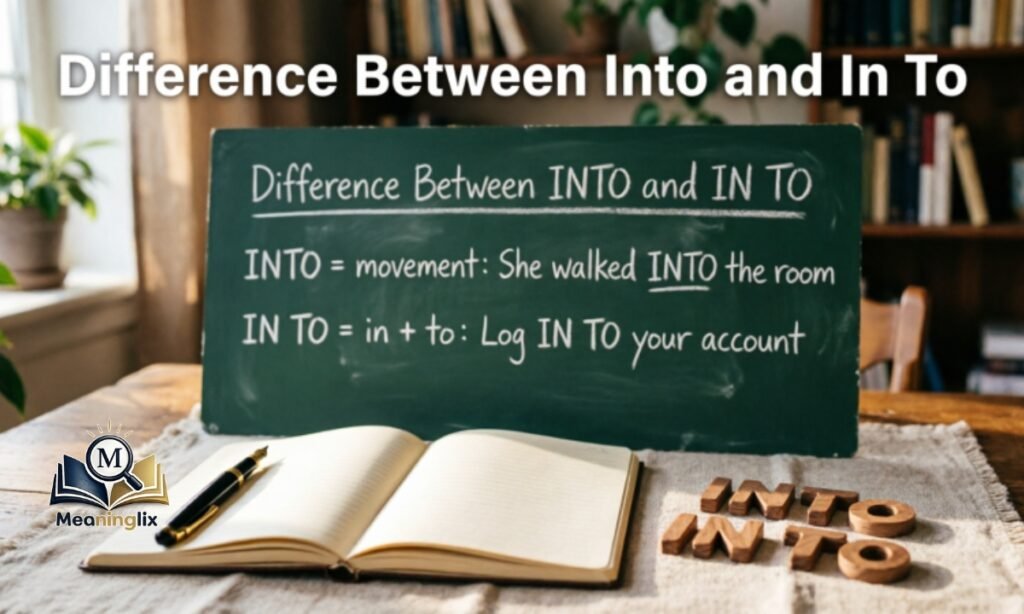
The core difference between into and in to comes down to grammar function, not spelling preference. Into is a preposition that shows direction, entry, or transformation. In to, on the other hand, is simply the adverb “in” followed by the preposition “to,” and each word keeps its own job in the sentence.
A quick way to spot the difference is to look at the words on either side. If removing “to” still leaves a complete, sensible verb phrase (like “log in” or “turn in”), you likely need in to. If the sentence describes motion, entry, or change, into is almost always the right choice.
| Word | Meaning | Usage | Example | Correct Situation |
| Into | Movement, direction, or change | Preposition showing entry or transformation | She walked into the kitchen. | Use when something moves toward or becomes part of something else |
| In To | Two separate words: “in” plus “to” | “In” completes a verb phrase; “to” starts a new phrase | He turned in to hand back the form. | Use when “in” belongs to the verb and “to” introduces a purpose or action |
Read Now : Breath vs Breathe
Definitions
What Does Into Mean?
Into is a single-word preposition. It describes motion toward the inside of a place, object, or condition. It can also describe a change from one form or state to another, such as ice turning into water.
What Does In To Mean?
In to is not one word at all. It is the adverb “in,” which often pairs with a verb (like “come in,” “check in,” or “log in”), followed by the separate preposition “to,” which usually leads into an infinitive verb or a destination. Each word keeps its own independent meaning.
When to Use Into
Use into whenever you want to describe movement toward the inside of something, a transformation, or contact between two things. Here are five original example sentences.
- The cat jumped into the empty box.
- Sunlight poured into the quiet classroom.
- The recipe says to mix the eggs into the batter slowly.
- Nervous energy turned into pure excitement once the show started.
- He bumped into an old friend at the grocery store.
In each sentence, into shows a clear shift, entry, or contact point. Notice how the word always connects two things: a subject and a place, object, or new condition.
When to Use In To
Use in to when “in” is part of a verb phrase and “to” separately introduces the next idea, often an infinitive. Here are five original example sentences.
- She stopped in to say hello before her meeting.
- Please turn in to your manager the finished report by Friday.
- He gave in to the pressure and agreed to help.
- The students filed in to take their seats quietly.
- We dropped in to check on our neighbors after the storm.
In each case, you can test the sentence by pausing after “in.” The verb phrase still makes sense on its own, and “to” simply starts the next part of the thought.
Side-by-Side Comparison
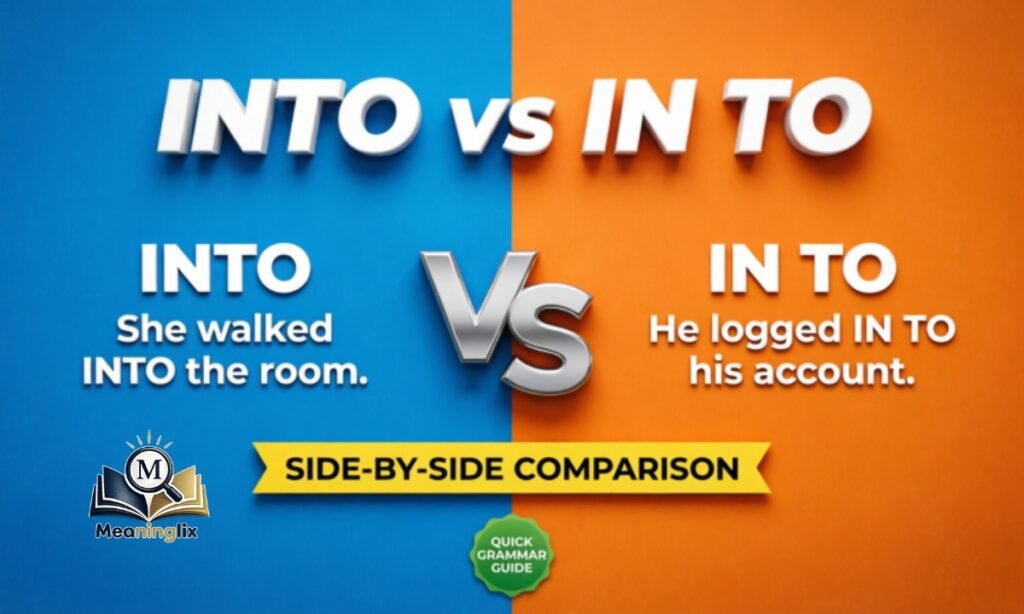
| Feature | Into | In To |
| Number of words | One word | Two separate words |
| Part of speech | Preposition | Adverb (“in”) plus preposition (“to”) |
| Main function | Shows direction, entry, or transformation | Connects a verb phrase to an infinitive or purpose |
| Common pattern | Subject + verb + into + place/object | Subject + verb phrase (with “in”) + to + verb |
| Quick test | Sentence describes movement or change | Sentence still works if you pause after “in” |
| Example | They walked into the museum. | They walked in to see the exhibit. |
Common Mistakes
Many learners write “into” when they actually need in to, especially with verbs like “turn in,” “log in,” “give in,” or “check in.” The verb phrase gets separated from “to” by mistake, and the two words get glued together.
The opposite mistake also happens often. Writers sometimes split into into “in to” when describing simple movement, such as writing “She walked in to the room” instead of the correct “She walked into the room.” This confusion grows because both phrases sound identical when spoken aloud.
Another common error involves phrasal verbs. Phrases like “log in to your account” require the separate words “in” and “to,” since “log in” is the verb and “to your account” is where you are logging in. Writing “log into your account” is actually accepted informally, but careful writers often keep them separate when “log in” functions as a standalone phrasal verb.
Click Here To Read : Everyday vs Every Day
Easy Trick to Remember
Try the pause test. Say your sentence out loud and pause right after the word “in.” If the sentence still makes complete sense on its own, like “She went in,” then you need the two-word form, in to, because “to” is starting a fresh idea.
If pausing there leaves the sentence feeling broken or incomplete, like “The ball rolled in,” and it clearly needs the next word to finish the thought, then into is correct. This one small habit clears up the into or in to confusion almost every time.
Real-Life Examples

- The kids ran into the yard the moment school ended.
- He came in to grab his umbrella before the rain started.
- Mixing blue and yellow paint turns into green.
- She logged in to check her email before breakfast.
- The car swerved into the empty parking lot.
- They walked in to warm up after shoveling snow.
- His hard work turned into a well-deserved promotion.
- Please hand in to the front desk any lost items you find.
- The hikers disappeared into the thick fog.
- We stopped in to thank the volunteers for their help.
Common Questions
Is “into” correct in every sentence with movement? Not always. “Into” fits movement toward the inside of something, but simple direction words like “toward” or “onto” may fit better depending on the exact meaning you want to express.
Can I use “into” instead of “in to”? No, not when “in” is part of a verb phrase like “turn in,” “log in,” or “give in.” Swapping in into there changes the sentence’s meaning or makes it grammatically incorrect.
Why do people confuse them? Both phrases sound identical in speech, and spelling rules for combining prepositions are not obvious. Readers rely on context and grammar function, which takes more thought than sound alone.
Similar Grammar Confusions
- Onto vs On To
- Everyday vs Every Day
- Its vs It’s
- Affect vs Effect
- Alot vs A Lot
Frequently Asked Questions
Is “in to” ever used before a noun?
Rarely, since “to” before a noun usually attaches to a verb phrase rather than standing alone. Most “in to” sentences continue with a verb, like “in to see” or “in to check,” rather than jumping straight into a noun phrase.
Does British English treat into or in to differently?
British and American English follow the same core rule for into or in to. The difference lies mainly in which phrasal verbs are common in each dialect, not in the grammar rule itself.
Can “into” ever be replaced by “in to” without changing meaning?
No, because the two forms serve different grammatical roles. Replacing one with the other usually creates an awkward or incorrect sentence, even though they sound the same when spoken.
Is it correct to write “log into” or “log in to” an account?
Both appear in modern writing, though “log in to” is grammatically more precise since “log in” is the verb phrase. Many style guides now accept “log into” as a natural, evolving form.
What is the fastest way to check into or in to while proofreading?
Read the sentence aloud and pause after “in.” If the sentence already makes sense, you need “in to.” If it feels incomplete without the next word, “into” is the correct choice.
Key Takeaways
- Into is one word showing movement, direction, or transformation.
- In to is two words, where “in” pairs with a verb and “to” starts a new phrase.
- The pause test after “in” quickly reveals which form fits.
- Phrasal verbs like “log in,” “turn in,” and “give in” almost always need the two-word form “in to.”
- Sentences describing entry, contact, or change are almost always needed into.
- Both forms are grammatically correct English, just for different jobs.
Conclusion
Choosing correctly between into or in to becomes simple once you understand what each word is doing in your sentence. Into points to movement, entry, or change, while in to keeps two independent words working side by side, usually around a verb phrase.
Practice the pause test whenever you feel unsure, and read your sentence slowly before finalizing it. With a little attention, this common mix-up will disappear from your writing, and your sentences will be read clearly and correctly every time.

Alisha Lehmann is the founder and author of Meaninglix. She specializes in explaining word meanings, internet slang, abbreviations, grammar, and English expressions in simple, accurate language. Her goal is to help readers improve their vocabulary and communicate confidently through clear, well-researched, and easy-to-understand content.
1 thought on “Into or In To: The Simple Rule to Get It Right 2026”