
You’re typing an email and your cursor hovers over the keyboard. Is it “please login to your account” or “please log in to your account”? Both look right, and that’s exactly why so many people freeze on this one. Here’s the quick fix: “login” is a noun or adjective, and “log in” is a verb. If someone is performing the action, use two words. If you’re naming the thing itself, use one.
Table of Contents
The Quick Answer “Login or Log In”
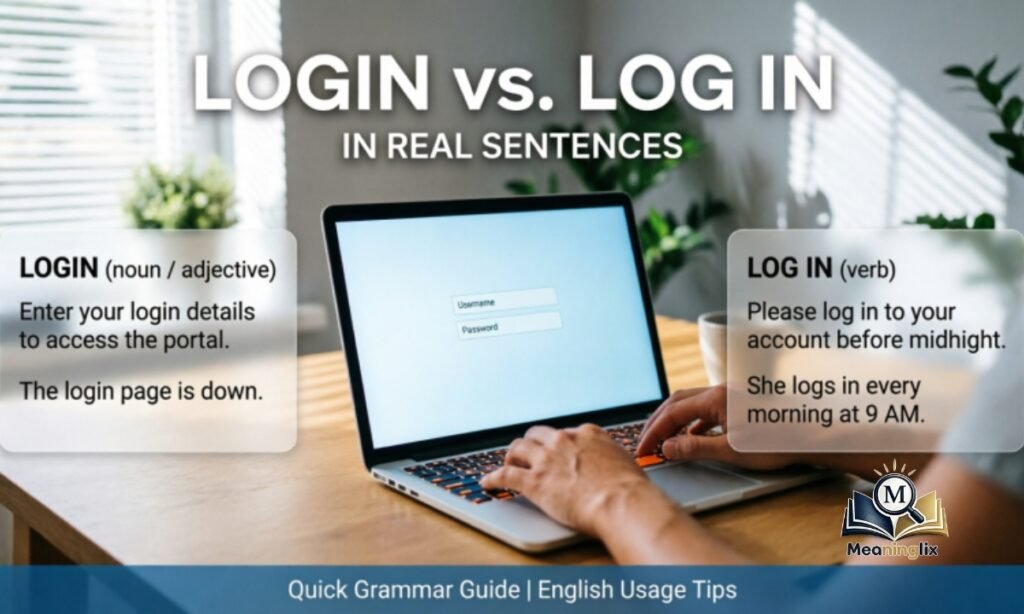
Log in (two words) is what you do, it’s the action of entering your username and password. Login (one word) is what you call something a screen, a page, or a set of credentials.
So you log in using your login information. Once you know which job the word is doing in your sentence, the choice stops being a guess.
What “Login” Actually Means

Login is a noun, and sometimes an adjective, formed by combining “log” and “in” into a single closed compound. As a noun, it refers to the credentials or the act of accessing a system, as in “I forgot my login.” As an adjective, it describes something related to that access, as in “the login page” or “the login button.”
You’ll never use “login” as a verb. If you catch yourself writing “please login here,” that’s the noun form doing a verb’s job and that’s the single most common mistake with this word.
Read Also : Backup or Back Up:
What “Log In” Actually Means

Log in is a phrasal verb two separate words that work together to describe an action. It means to sign into an account, device, or system, typically with a username and password. Because it’s a verb, it changes form depending on the tense: you log in today, you logged in yesterday, and you are logging in right now.
The space between “log” and “in” isn’t optional. It’s the visual signal that tells a reader this word is doing something, not just naming something.
Confused : Setup or Set Up
Why the Confusion Happens “Login or Log In”
English quietly turns a lot of phrasal verbs into single-word nouns over time, think of “workout” (noun) versus “work out” (verb), or “setup” (noun) versus “set up” (verb). “Login” followed the same pattern. Because the noun and verb sound identical when spoken, the ear can’t tell you which spelling to use. Only the sentence’s grammar can.
Autocorrect and casual writing habits make it worse. Once people see “login” everywhere on buttons, in URLs, in app menus they start assuming it covers every use, including the verb.
Login or Log In at a Glance

| Term | Part of Speech | Meaning | Typical Use | Example |
| Login | Noun / Adjective | The credentials or access point | Naming a screen, button, or set of details | “Enter your login and password.” |
| Log in | Verb (phrasal) | The act of signing in | Describing an action someone performs | “Please log in before 9 a.m.” |
| Logged in | Verb (past tense) | Already signed in | Describing a completed action or current state | “I’m already logged in.” |
| Logging in | Verb (present participle) | In the process of signing in | Describing an ongoing action | “She’s logging in now.” |
Read Also : Todays or Today’s
A Simple Test to Pick the Right One “Login or Log In”
Ask yourself: is this word acting, or is it naming something?
- If you can replace it with “sign in” or “access,” you need the verb log in.
- If you can replace it with “credentials” or “sign-in page,” you need the noun login.
- If the word comes right before a noun, describing it, use the adjective login (as in “login attempt”).
Run any sentence through that quick swap test, and the right form usually becomes obvious within a second or two.
Login or Log In in Real Sentences
Everyday conversation “Login or Log In”
- Correct: “I can’t remember how to log in to the Wi-Fi.”
- Incorrect: “I can’t remember how to login to the Wi-Fi.” (An action needs the two-word verb.)
Workplace communication “Login or Log In”
- Correct: “IT reset your login so you can log in again.”
- Incorrect: “IT reset your log in so you can login again.” (The forms are swapped here noun and verb are reversed.)
School or academic writing “Login or Log In”
- Correct: “Students must log in using their student ID number.”
- Incorrect: “Students must login using their student ID number.”
Text messages or social media “Login or Log In”
- Correct: “Can’t log in, app keeps crashing lol”
- Incorrect: “Can’t login, app keeps crashing lol”
Formal writing “Login or Log In”
- Correct: “Your login credentials will expire in 30 days. Please log in before then to reset them.”
- Incorrect: “Your log in credentials will expire in 30 days. Please login before then to reset them.”
Read Also : Accept vs Except
Mistakes People Make Most Often “Login or Log In”
The biggest slip is using “login” where a verb is needed writing “login to your account” instead of “log in to your account.” It happens because “login” is so visually familiar from app interfaces that it starts to feel like the default spelling for everything.
The reverse mistake is less common but still shows up: writing “your log in” when you mean the noun, as in “I forgot my log in” instead of “I forgot my login.” A simple memory trick fixes both: if you can put “to” right after it and the sentence still makes sense, it’s the verb “log in to the site.” If it sounds more like a label, it’s the noun “the login screen.”
Related Terms Worth Knowing
- Log on / logon follows the exact same pattern as log in/login “logon” is the noun, “log on” is the verb. It’s slightly older-sounding but still used in some technical contexts.
- Sign in / sign-in works the same way “sign in” is the verb, “sign-in” is the noun or adjective.
- Log out / logout mirrors the pattern too you log out (verb) using the logout button (noun/adjective).
Once this pattern clicks for one pair, it applies cleanly to the others.
A Quick Trick to Lock It In
Picture the one-word version, login, as a locked door with a nameplate on it it’s a thing you look at. Picture the two-word version, log in, as the act of turning the key it’s something you do.
If your sentence describes an action, you need two words and a little movement between them, just like turning a key takes a moment.
FAQs “Login or Log In”
Is “login” grammatically correct?
Yes, but only as a noun or adjective. “Login” is correct in phrases like “enter your login” or “the login page.” It’s incorrect when used as a verb, such as “please login here” that sentence needs the two-word form, “log in.”
What is the difference between “login” and “log in”?
“Login” is a noun or adjective that names something, like credentials or a webpage. “Log in” is a verb phrase describing the action of accessing an account. You use your login to log in.
Is “log in” one word or two?
“Log in” is always two words when it’s functioning as a verb. It only becomes one word, “login,” when it shifts to being a noun or adjective.
Which one should I use in a sentence like “click here to ___”?
Use the verb form, log in, since “click here to log in” describes an action. The one-word “login” would only fit if you were naming something, such as “click here for login help.”
The Bottom Line
The whole distinction comes down to one question: is the word naming something or doing something? Login names a page, a button, a set of credentials.
Log in does the act of signing into an account. Keep that split in mind, run the quick “to” test when you’re unsure, and this mix-up won’t trip you up again.

Alisha Lehmann is the founder and author of Meaninglix. She specializes in explaining word meanings, internet slang, abbreviations, grammar, and English expressions in simple, accurate language. Her goal is to help readers improve their vocabulary and communicate confidently through clear, well-researched, and easy-to-understand content.
1 thought on “Login or Log In? The Simple Rule That Settles It 2k26”