If your event got called off and you’re staring at your screen unsure whether to type “cancelled” or “canceled,” you’re not making a mistake, you’re just caught between two dialects. Both spellings are correct.
“Canceled” (one L) is standard in American English, while “cancelled” (two Ls) is standard in British English. Neither one is a typo; the right choice simply depends on which form of English you’re writing in.
Table of Contents
What Does “Cancel” Actually Mean?

Before getting into the spelling debate, it helps to nail down the meaning. Cancel is a verb meaning to stop something from happening, to call off a plan, or to make something no longer valid. You cancel a flight, a subscription, a meeting, or a plan with a friend.
Both “canceled” and “cancelled” are simply the past tense form of this verb. They describe something that has already been called off. The two spellings carry the exact same meaning there’s no difference in what they communicate, only in how they’re spelled.
Canceled vs. Cancelled: The Core Rule
Here’s the rule in one sentence: use “canceled” if you’re writing American English, and “cancelled” if you’re writing British English.
This split comes down to a general pattern in how the two dialects handle verbs ending in a single vowel plus “L,” like cancel, travel, or label. British English almost always doubles the final “L” before adding an ending such as -ed or -ing. American English typically does not, unless the stress falls on that final syllable (which is why “control” becomes “controlled” in both dialects, but “cancel” does not follow the same pattern in the US).
That single rule explains a whole family of related word pairs:
- traveled / travelled
- labeled / labelled
- modeled / modelled
- signaled / signalled
If you already know one of these, you know all of them the logic is identical across the board.
Why Two Spellings Exist for the Same Word
The short answer is Noah Webster. In the early 1800s, Webster set out to simplify American spelling and make it more consistent with pronunciation. His dictionaries trimmed extra letters from many words, including doubled consonants that didn’t affect how a word sounded. “Canceled” was one result of that simplification.
British English never adopted those changes, so it kept the older double-L pattern that had been used since well before Webster’s reforms. Neither version is more “correct” in an absolute sense; they simply reflect two different spelling traditions that developed on either side of the Atlantic.
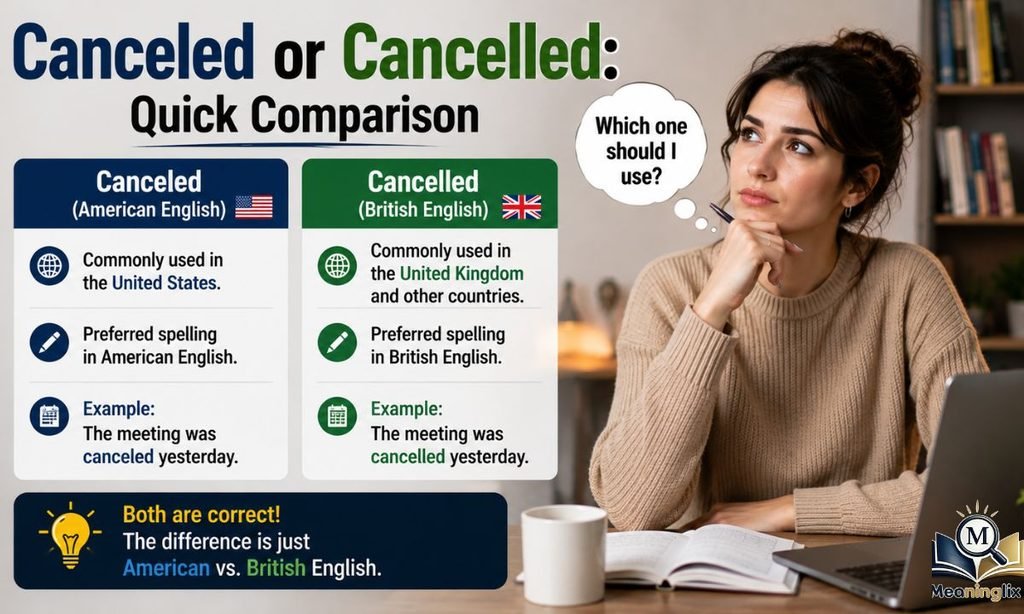
Canceled or Cancelled: Quick Comparison
| Term | Correct? | Region | Example |
| Canceled | Yes | American English | “The flight was canceled due to weather.” |
| Cancelled | Yes | British, Australian, Canadian English | “The flight was cancelled due to weather.” |
Both rows are grammatically valid. The only variable is your audience.
Which Spelling Should You Use?
Match your spelling to your reader, not to personal preference. A simple way to decide:
- Writing for a US audience, US company, or American publication? Use canceled.
- Writing for a UK, Australian, Canadian, or Irish audience? Use cancelled.
- Following a specific style guide? Check it AP Style and most American style guides specify canceled, while Oxford and most British guides specify cancelled.
- Writing for an international or mixed audience? Pick one spelling and use it consistently throughout the document.
The biggest mistake isn’t choosing the “wrong” regional spelling, it’s mixing both spellings in the same piece of writing.
Don’t Miss : Me vs. Myself vs. I
Real-Life Examples
Everyday conversation: “My dentist appointment got canceled, so I’m free tonight.”
Text message: “Practice is cancelled, see you tomorrow instead.”
Workplace email: “Please note that Friday’s client meeting has been canceled and will be rescheduled for next week.”
Academic writing (UK): “The lecture was cancelled due to a scheduling conflict with the main hall.”
Social media: “Ugh, the concert just got canceled. Refunds are already going out.”
Each of these sentences works perfectly in its own regional context. The word is doing the same job in every example only the spelling shifts.
What About “Canceling” and “Cancellation”?
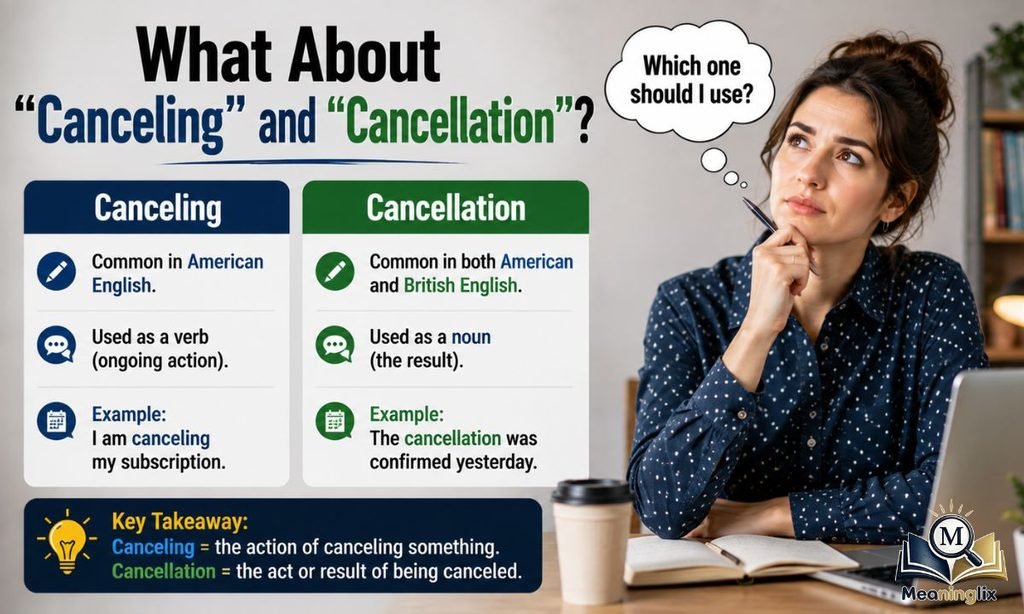
The same doubling rule applies to related forms, with one important exception.
- Canceling / Cancelling: Follows the same pattern as the past tense. American English uses canceling; British English uses cancelling.
- Cancellation: This one breaks the pattern. Both American and British English use the double-L spelling, cancellation. There is no widely accepted single-L alternative in standard usage, even in American writing.
So while “canceled” drops a letter in American English, “cancellation” keeps both Ls no matter where you’re writing from. This exception trips up a lot of writers who assume the American simplification applies everywhere in the word family. It doesn’t.
Common Mistakes to Avoid
Mistake 1: Switching spellings mid-document. Incorrect: “The show was cancelled, so all canceled tickets will be refunded.” Why it happens: Writers often see both spellings so frequently online that they stop noticing which one they used. Pick one form at the start and stick with it.
Mistake 2: Assuming “cancelation” (one L) is acceptable for the noun. Incorrect: “We apologize for the cancellation of your order.” Correct: “We apologize for the cancellation of your order.” The single-L noun form is rare and generally considered nonstandard, even in American English.
Mistake 3: Treating one spelling as flatly wrong. Neither “canceled” nor “cancelled” is a spelling error on its own. The only real error is using the wrong one for your intended audience or style guide.
A simple way to remember the divide: American English trims extra letters (color, favorite, canceled), while British English tends to preserve them (colour, favourite, cancelled). If you remember that one contrast, the rest of the pattern falls into place.
Formal Writing and Style Guides
If you’re writing for a specific publication, company, or academic institution, check its house style before defaulting to instinct:
- AP Style (used by most US newspapers and many businesses): canceled, canceling, cancellation
- Chicago Manual of Style (common in US book publishing): canceled, canceling
- Oxford style / most UK publishers: cancelled, cancelling, cancellation
When no style guide applies, default to the spelling that matches your audience’s country, and stay consistent for the rest of the document.
Frequently Asked Questions
Is “cancelled” grammatically incorrect in American English?
No. “Cancelled” isn’t grammatically wrong in the US, it’s simply the British spelling. American style guides like AP Style recommend “canceled,” but using “cancelled” won’t confuse a reader or break any grammar rule. It will just look slightly less standard in US-based writing.
Is “canceled” wrong in British English?
It’s not “wrong” in the sense of breaking a grammar rule, but it will look American to a British reader. UK publications and style guides consistently use “cancelled,” so “canceled” would stand out as inconsistent with standard British usage.
What’s the difference between “canceled” and “cancellation”?
“Canceled” is the past tense of the verb cancel and follows regional spelling rules (one L in American English, two in British English). “Cancellation” is the noun form and always uses two Ls in both dialects there’s no regional variation for this particular word.
Does spell-check flag the “wrong” version?
It can. Spell-checkers set to American English will often underline “cancelled,” and those set to British English will flag “canceled.” This isn’t a grammar error on your part, it just means your spell-check language setting doesn’t match the spelling you used.
The Bottom Line
Both “canceled” and “cancelled” are correct; the choice comes down to American versus British English, not right versus wrong. Use canceled for US audiences and style guides, use cancelled for UK, Australian, or Canadian audiences, and keep your spelling consistent throughout whatever you’re writing.
The one exception worth remembering is “cancellation,” which keeps its double L everywhere.

Alisha Lehmann is the founder and author of Meaninglix. She specializes in explaining word meanings, internet slang, abbreviations, grammar, and English expressions in simple, accurate language. Her goal is to help readers improve their vocabulary and communicate confidently through clear, well-researched, and easy-to-understand content.
4 thoughts on “Cancelled vs Canceled: Discover the Correct Spelling”