If you’ve paused mid-sentence wondering whether to type “while” or “whilst,” you’re not alone. Both words look correct, both sound like real English, and spellcheck rarely flags either one. Here’s the direct answer: “while” is correct in American English, and “whilst” is the British variant. In everyday US writing, always choose “while.”
Table of Contents
The Quick Answer “While or Whilst”
“While” and “whilst” mean the same thing. They’re both used to show that two things happen at the same time, or to point out a contrast between two ideas. The difference isn’t about meaning — it’s about region and formality.
- While — standard in American English, used constantly in both speech and writing.
- Whilst — used mainly in British English, and even there it sounds noticeably formal or old-fashioned.
For a US audience, “while” is always the safer, more natural choice. “Whilst” isn’t wrong, but it can come across as stiff or overly formal to American readers.
Why People Get Confused “While or Whilst”
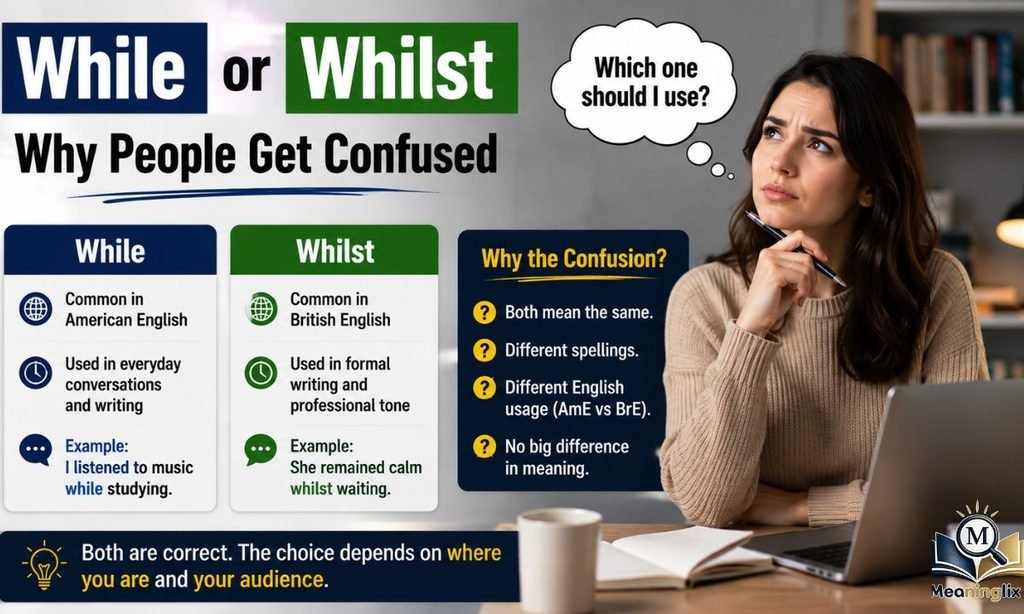
The confusion usually comes from reading British books, articles, or emails that use “whilst” and assuming it’s a fancier or more “correct” version of “while.” It isn’t. Some writers pick up “whilst” because it sounds sophisticated, then start sprinkling it into casual American writing where it feels out of place — a bit like wearing a tuxedo to a backyard barbecue.
The two words developed from the same root in Middle English, which is why they still function almost identically today. Over time, American English simplified to “while,” while British English kept both forms alive, with “whilst” reserved for more formal contexts.
What “While or Whilst” Actually Mean
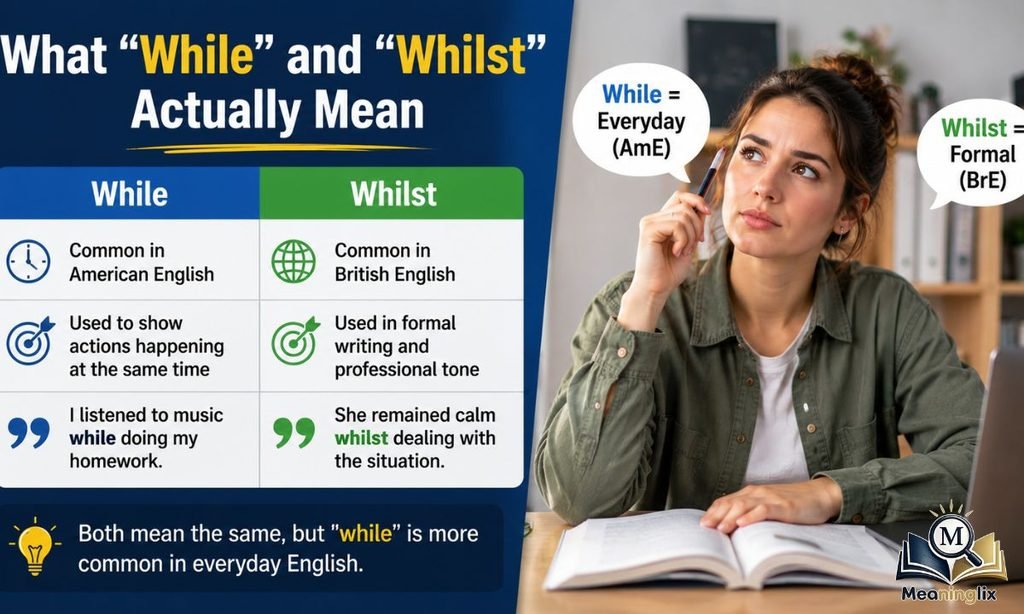
Used as a conjunction, “While or Whilst means one of two things:
- At the same time as — describing two things happening simultaneously.
- Whereas / although — showing a contrast between two facts or ideas.
Example (time): “She answered emails while waiting for her coffee.”
Example (contrast): “He prefers tea, while his sister prefers coffee.”
Swap in “whilst” for either sentence and the meaning stays exactly the same — only the tone shifts toward more formal, British-leaning English.
American English vs. British English “While or Whilst”
This is really where the whole debate lives. Here’s how the two dialects treat these words:
| Region | Preferred Form | Typical Tone |
| American English | While | Neutral, natural in all writing |
| British English | Whilst or While | Whilst = formal; While = everyday |
| Canadian English | While | Similar to American usage |
| Australian English | While (whilst also accepted) | Whilst sounds more traditional |
Even in Britain, “while” is used far more often than “whilst” in daily conversation. “Whilst” tends to show up in reports, legal writing, academic papers, and other formal documents rather than in casual speech or texts.
Quick Comparison Table “While or Whilst”
| Term | Correct? | Meaning | Typical Use | Example |
| While | Yes (US & UK) | At the same time as / whereas | Everyday speech and writing, all English dialects | “I read while I ate lunch.” |
| Whilst | Yes (UK, formal) | At the same time as / whereas | Formal British writing, rarely spoken casually | “She waited whilst the report was finalized.” |
The One Place They Aren’t Interchangeable
Here’s a detail most articles skip: “while” can do more grammatical jobs than “whilst” can.
“While” can function as:
- A conjunction: “While you cook, I’ll set the table.”
- A noun, meaning a period of time: “Let’s talk for a while.”
- A verb, meaning to pass time leisurely: “We whiled away the afternoon on the porch.”
“Whilst” can only function as:
- A conjunction or adverb — never as a noun or a verb.
That means you can never say “for a whilst” or “we whilst away the afternoon.” Those constructions are always wrong, in both American and British English.
Correct and Incorrect Examples “While or Whilst”
Correct: “While I was driving, my sister called.”
Correct (British, formal): “Whilst the committee reviewed the proposal, staff continued regular operations.”
Incorrect: “I need a whilst to think this over.” Why it’s wrong: “Whilst” cannot be used as a noun. Only “while” works here: “I need a while to think this over.”
Incorrect (in American writing): “Whilst I finish this report, can you grab lunch?” Why it’s awkward: Not grammatically wrong, but it reads as unnaturally formal for casual American communication. “While” is the natural choice here.
Common Mistakes to Avoid “While or Whilst”
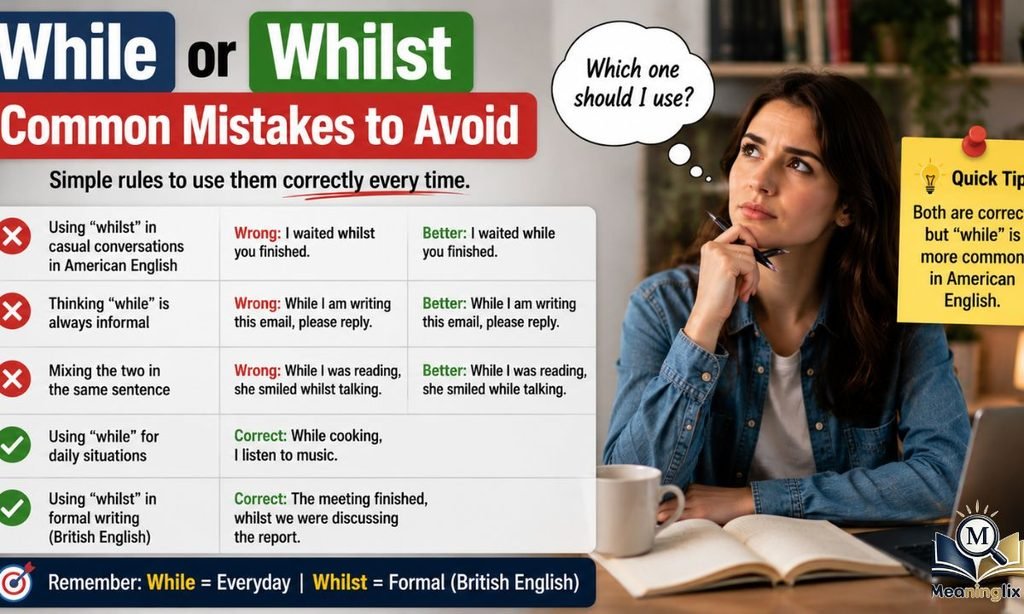
The biggest mistake isn’t grammatical — it’s tonal. Writers often use “whilst” thinking it sounds more polished, when in American contexts it just sounds mismatched with the rest of the sentence.
- Mistake “While or Whilst“: Using “whilst” in a casual text or email to sound smarter. Fix: Use “while.” It reads as natural, not less intelligent.
- Mistake “While or Whilst“: Assuming “whilst” is more grammatically correct than “while.” Fix: Neither is more correct they’re regional variants. In the US, “while” is standard.
- Mistake “While or Whilst“: Using “whilst” as a noun (“for a whilst”). Fix: Only “while” works as a noun. Say “for a while” instead.
Simple way to remember it: If you’re writing for an American audience, picture “whilst” as belonging in a British period drama it fits there, not in a text message or work email.
Practical Usage Guidance “While or Whilst”
For US-based writing emails, essays, articles, social media, workplace communication — stick with “while.” It’s the correct spelling and grammar rule for American English, and it reads as clear and natural in every context, from casual conversation to formal reports.
If you’re writing for a British audience, or aiming for a deliberately formal or literary tone, “whilst” is an acceptable and correct alternative. Just be consistent: don’t mix “while” and “whilst” within the same document unless there’s a clear stylistic reason.
Related Terms Worth Knowing “While or Whilst”
A few nearby words often get folded into this same confusion:
- Awhile (one word, adverb): “Stay awhile.” Never followed by “for.”
- A while (two words, noun phrase): “Stay for a while.” Always follows a preposition like “for” or “in.”
- Whereas: A more formal synonym for the contrast meaning of “while,” common in legal and academic writing.
FAQs “While or Whilst”
Is “whilst” grammatically correct?
Yes. “Whilst” is grammatically correct, especially in British English, where it functions as a more formal version of “while.” It is not used much in American English, where “while” is standard.
What is the difference between “while” and “whilst”?
There’s no difference in core meaning — both indicate simultaneous action or contrast. The difference is regional and stylistic: “while” is the standard American form, and “whilst” is a more formal British form. For example, “While she cooked, he cleaned” and “Whilst she cooked, he cleaned” mean exactly the same thing.
Can Americans use “whilst”?
Technically yes, since it isn’t grammatically incorrect. However, most American readers find it old-fashioned or overly formal, so “while” is the better choice for US writing.
Which is more common, “while” or “whilst”?
“While” is far more common overall, even in British English. “Whilst” appears mainly in formal or written contexts, rarely in everyday conversation on either side of the Atlantic.
The Bottom Line “While or Whilst”
“While or Whilst” mean the same thing, and the choice between them comes down to region and tone rather than grammar.
American English writers should default to “while” in nearly every situation. Save “whilst” for British-style formal writing, and remember that only “while” can double as a noun or a verb. Once you know that one rule, the confusion disappears for good.

Alisha Lehmann is the founder and author of Meaninglix. She specializes in explaining word meanings, internet slang, abbreviations, grammar, and English expressions in simple, accurate language. Her goal is to help readers improve their vocabulary and communicate confidently through clear, well-researched, and easy-to-understand content.
1 thought on “While or Whilst: The Perfect Guide to Get It Right 2k26”