If you’ve typed “studder” and then stared at it wondering why it looks wrong, you’re not imagining things. The correct spelling is “stutter.” “Studder” is a common misspelling that shows up because of how the word sounds when spoken quickly, not because it’s an accepted alternative.
Once you know the rule, you’ll never second-guess it again.
Table of Contents
The Quick Answer

Stutter is the only correct spelling when you’re talking about a speech pattern involving repeated sounds, blocked words, or interrupted speech flow. “Studder” is not a recognized English word for this meaning, and you won’t find it defined this way in any major dictionary.
The mix-up almost always comes down to sound. When people say “stutter” out loud, the double “t” in the middle can blend and soften, making it sound closer to a “d.” Your ear hears “stud-der,” so your fingers type it that way. That’s a pronunciation habit, not a spelling rule.
Read Grammar : Grately or Greatly
What “Stutter” Actually Means
Stutter (verb): to speak with involuntary pauses, repeated sounds, or prolonged syllables. Stutter (noun): a speech pattern marked by these same interruptions, also called a speech disorder or fluency disorder.
Example: “He tends to stutter when he’s nervous in front of a crowd.”
The word can also describe non-speech situations where something moves or functions in a halting, interrupted way, such as an engine that stutters or a video feed that stutters and freezes.
Why “Studder” Isn’t a Real Word (With One Small Exception)
In everyday usage, “studder” has no meaning. It’s simply a misspelling. There is one narrow exception worth knowing: some dictionaries list “studder” as an obscure occupational term for a watchmaking worker who inserts hairsprings into watch studs.
This is a highly specialized, rarely used sense that has nothing to do with speech. If you’re writing about talking, communication, anxiety, or a speech disorder, “studder” is simply incorrect and should be corrected to “stutter.”
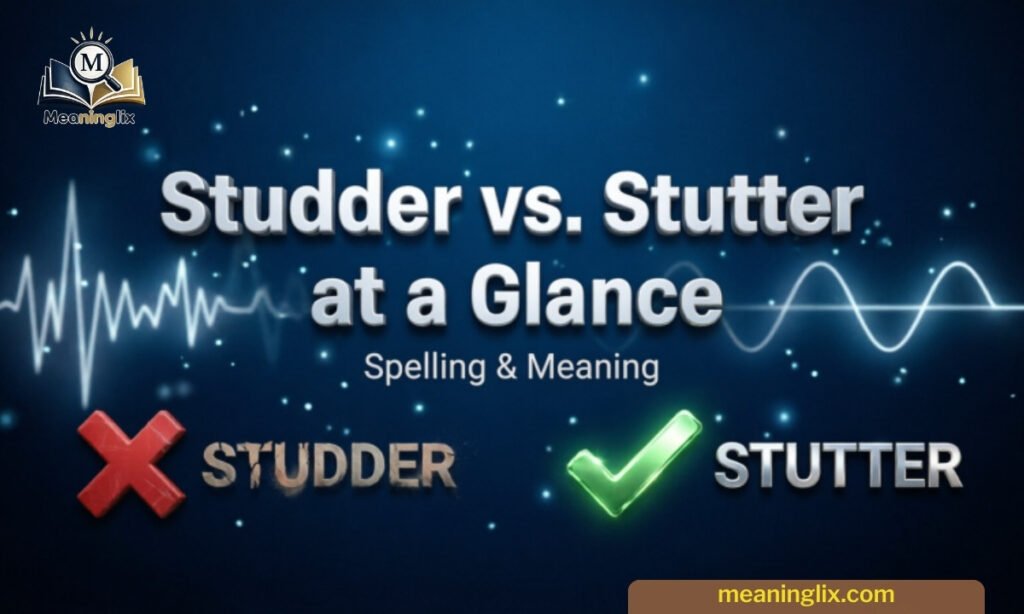
Studder vs. Stutter at a Glance
| Term | Correct? | Meaning | Typical Use | Example |
| Stutter | Yes | To speak with repeated or interrupted sounds | Everyday, medical, and academic writing | “Her stutter improved after speech therapy.” |
| Studder | No (in speech contexts) | Not a recognized word; rare watchmaking term only | Should not be used for speech | ~~”He has a studder.”~~ |
Read Also : Devide or Divide
Why the Confusion Happens
This isn’t a rare typo, it’s one of the most searched spelling questions related to speech. A few things drive the confusion:
- Sound blending: The double “t” in “stutter” often sounds like a soft “d” in casual American speech, similar to how “butter” and “ladder” can sound alike when spoken fast.
- Autocorrect gaps: Because “studder” is such an uncommon string of letters, some spell-checkers flag it inconsistently, letting the mistake slip through.
- Visual pattern matching: Words like “shudder,” “rudder,” and “udder” all use “-udder,” so the brain sometimes borrows that pattern for “stutter.”
Once you notice this pattern-matching effect, the mix-up makes a lot more sense and it becomes easier to catch yourself before hitting send.
A Simple Way to Remember the Rule
Picture the double “t” as two quick taps, mimicking the repeated sounds of an actual stutter. Stutter has two t’s, just like a stutter repeats sounds. That small mental image is usually enough to lock in the correct spelling for good.
Correct and Incorrect Examples
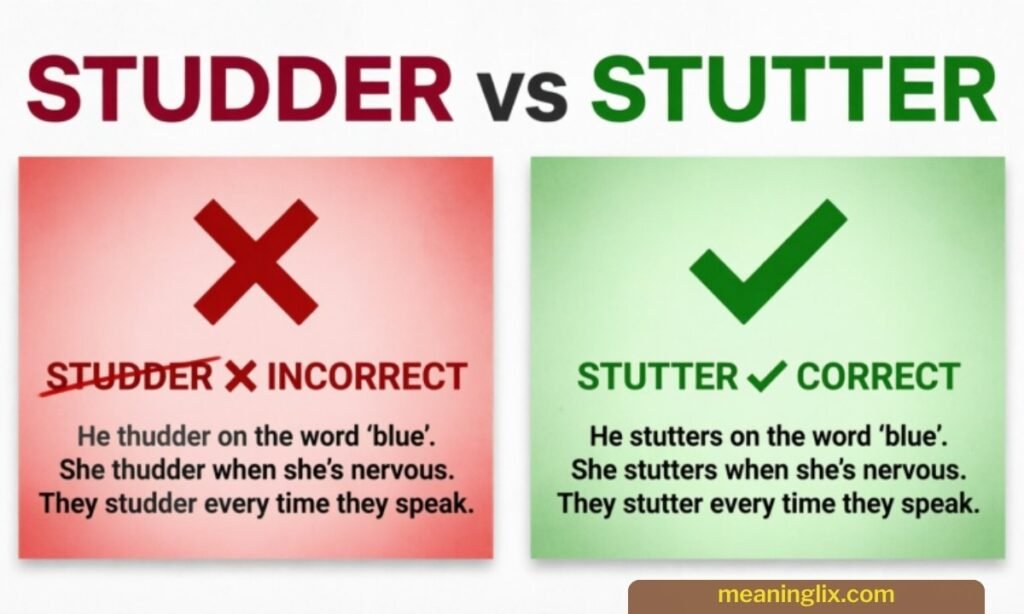
Correct: “The pressure of public speaking made his stutter more noticeable.”
Incorrect: “The pressure of public speaking made his studder more noticeable.”
Correct: “She’s been working with a speech therapist to manage her stutter.”
Incorrect: “She’s been working with a speech therapist to manage her studder.”
Correct: “The engine seemed to stutter before it finally started.”
Incorrect: “The engine seemed to studder before it finally started.”
In each incorrect example, “studder” simply isn’t a recognized word in this context, so the sentence reads as a spelling error rather than a stylistic choice.
Read Also : Okay or OK
How to Use “Stutter” in Real Sentences
Everyday conversation: “I get a little stutter when I’m put on the spot.”
School or academic writing: “Stuttering typically emerges in early childhood, often between ages two and six.”
Workplace communication: “He mentioned his stutter briefly before the presentation, just so the team understood the pauses.”
Text messages: “lol I totally stutter when I’m nervous, my bad”
Social media: “Proud of my son for reading his poem out loud today, stutter and all. 🎤”
Formal writing: “Individuals who stutter may benefit from structured speech therapy programs.”
Common Mistakes to Avoid
The main mistake is straightforward: writing “studder” instead of “stutter” anywhere related to speech. A few related slip-ups are worth flagging too.
- Dropping a letter under autocorrect pressure. Some people type “studder,” see a red squiggly line, and guess at a fix instead of confirming the correct spelling.
- Confusing “stutter” with “stammer.” These words are close cousins, not the same word misspelled. “Stammer” is more common in British English, while “stutter” is the standard term in American English. Both describe similar speech patterns, so either is understandable, but “stutter” is the expected choice for a US audience.
- Assuming “studder” is a valid alternate spelling. It isn’t. Unlike words with genuinely accepted variants (like “gray” and “grey”), “studder” has no recognized status as an alternate form of “stutter.”
Stutter vs. Stammer: A Quick Note
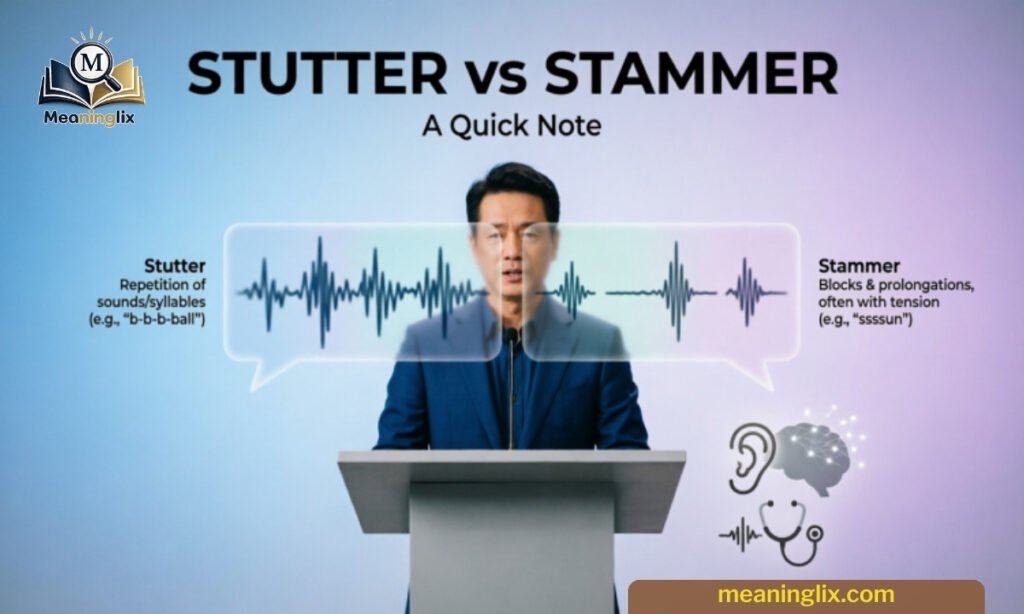
Since these two words often get grouped together, it helps to know where they overlap and where they don’t:
- Stutter: Preferred term in American English; also widely used in clinical and medical contexts worldwide.
- Stammer: More common in British English; describes essentially the same speech pattern.
Neither word is “more correct” than the other; the choice mostly comes down to regional preference. But “studder” isn’t a variant of either one; it’s simply a misspelling that should always be replaced with “stutter” or “stammer.”
Practical Guidance for Writers
Before publishing or sending anything that mentions this word, run a quick mental check:
- Are you talking about a speech pattern, interruption, or halting movement? Use stutter.
- Does your spell-checker flag “studder”? Trust it this is not an accepted spelling.
- Writing for a British audience and want a regional match? Stammer is an acceptable substitute for “stutter,” but “studder” never is.
Following this quick sequence takes just a few seconds and prevents a spelling error that can undercut otherwise polished writing, especially in academic, medical, or professional content.
Frequently Asked Questions
Is “studder” ever grammatically correct?
No, not in relation to speech. “Studder” isn’t recognized as a standard English word for this meaning in any major dictionary. The only documented use of “studder” is a narrow, unrelated watchmaking term, so for speech, communication, or a speech disorder, “stutter” is always the correct spelling.
What is the difference between “stutter” and “stammer”?
They describe the same type of speech pattern involving repeated or interrupted sounds. “Stutter” is the standard term in American English, while “stammer” is more commonly used in British English. For example, an American writer would say “he has a stutter,” while a British writer might say “he has a stammer.”
Why do so many people misspell “stutter” as “studder”?
The mistake usually comes from pronunciation. When “stutter” is spoken quickly, the double “t” can sound softer, closer to a “d” sound, which leads writers to spell it the way it sounds rather than the way it’s actually written.
Is “stutter” a noun, a verb, or both?
It’s both. As a verb, it means to speak with involuntary pauses or repeated sounds, as in “he tends to stutter under pressure.” As a noun, it refers to the speech pattern itself, as in “her stutter became less noticeable over time.”
The Bottom Line
Stutter is the correct spelling every time you’re referring to a speech pattern, and studder is a misspelling that should be corrected on sight.
Remembering the double “t” as a small echo of the repeated sounds in an actual stutter is an easy way to keep this one straight for good.

Alisha Lehmann is the founder and author of Meaninglix. She specializes in explaining word meanings, internet slang, abbreviations, grammar, and English expressions in simple, accurate language. Her goal is to help readers improve their vocabulary and communicate confidently through clear, well-researched, and easy-to-understand content.
1 thought on “Studder or Stutter: The Simple Rule to Get It Right 2k26”