
If you’ve ever typed “it’s quiet cold outside” and paused, wondering if that looks wrong, you’re not alone. Quiet vs. Quite are two completely different words with two completely different jobs, but their near-identical spelling trips up even confident writers.
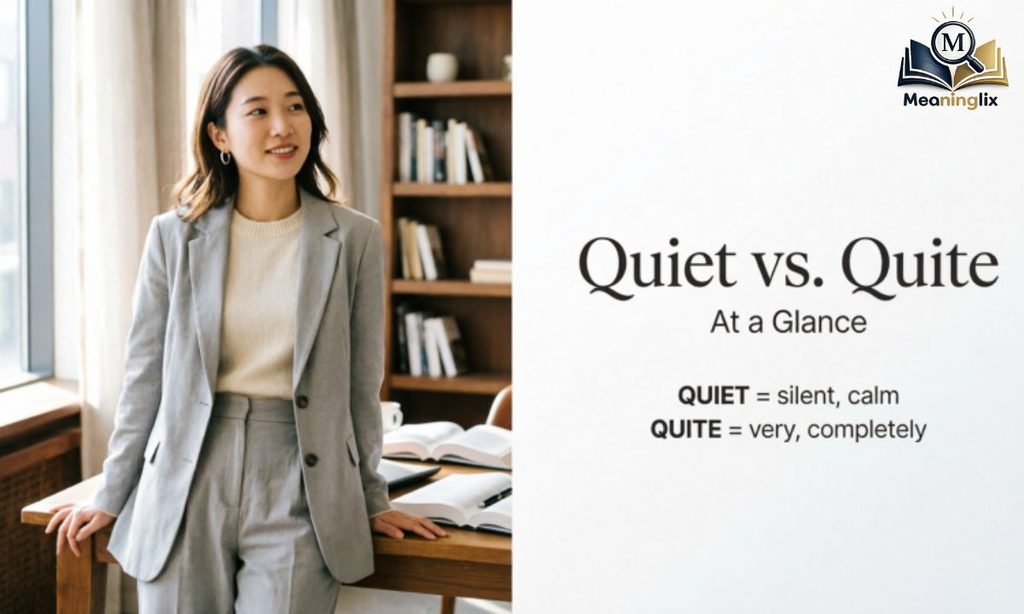
Here’s the short version: quiet means silent or calm, and quite means very or completely. One describes noise (or the lack of it); the other describes degree.
Once you see why the mix-up happens, you’ll stop second-guessing yourself for good.
Table of Contents
Quiet vs. Quite at a Glance
| Word | Part of Speech | Meaning | Typical Use | Example |
| Quiet | Adjective, noun, or verb | Free from noise or disturbance | Describing sound, calm, or stillness | “The library was quiet.” |
| Quite | Adverb | Very, completely, or to a fair degree | Intensifying an adjective, adverb, or verb | “The library was quite empty.” |
That single table answers most of the confusion, but the why behind it is worth knowing so the rule sticks.
What Does “Quiet” Mean?
Quiet refers to an absence of noise or a state of calm. It’s a flexible word that can work as an adjective, a noun, or even a verb, depending on the sentence.
- As an adjective, quiet describes something or someone making little to no sound: The baby finally fell quiet.
- As a noun, quiet refers to the state of calm itself: All I wanted was a little peace and quiet.
- As a verb, quiet means to calm something down or reduce noise: She tried to quiet the crying toddler.
Across all three uses, the core idea stays the same: low noise, low activity, low disturbance.
What Does “Quite” Mean?
Quite is an adverb, full stop it never functions as anything else. Its job is to intensify or adjust the strength of an adjective, another adverb, or occasionally a verb. Depending on context, it can mean:
- Very or completely: The results were quite surprising.
- Fairly or to a certain degree: It’s quite warm today, but not unbearable.
- Really or truly (informal agreement): “That was a strange call.” “Quite.”
Because quite’s exact strength shifts with the word it modifies, it’s less about a fixed meaning and more about degree. “Quite good” reads as pretty solid praise, while “quite ruined” reads as total.
Why People Mix Up Quiet vs. Quite

The confusion almost never comes from misunderstanding the meanings it comes from the spelling. The two words differ by a single letter, and that letter (the “e” before “t” versus after it) is easy to drop or add without noticing, especially when typing quickly.
Pronunciation doesn’t help either. Quiet has two syllables (KWY-et), while quite has one (rhymes with “kite”). But when you’re reading silently rather than saying the word aloud, that difference in sound doesn’t register, and your eyes see two very similar strings of letters.
The Simple Test to Pick the Right Word “Quiet vs. Quite”
Before you commit to either spelling, try this substitution trick:
- Swap in “silent” or “calm.” If the sentence still makes sense, you need to be quiet. “The room was silent” works, so “the room was quiet” is correct.
- Swap in “very” or “completely.” If that fits instead, you need quite. “The room was very cold” works, so “the room was quite cold” is correct.
If neither swap sounds right, reread the sentence you may need a different word entirely.
Quiet vs. Quite in Real Sentences

Correct: “Please keep quiet during the exam.” (Describes low noise as an adjective.)
Incorrect: “Please keep quite during the exam.” (Quite can’t mean “silent”; it has no noise-related meaning at all.)
Correct: “I was quite nervous before the interview.” (Intensifies “nervous” as an adverb.)
Incorrect: “I was quiet nervous before the interview.” (Quiet can’t intensify an adjective; it isn’t an adverb.)
Correct: “The office is quite quiet on Fridays.” (Both words appear correctly and quite modifies quiet.)
Incorrect: “The office is quiet quite on Fridays.” (Reversing the order breaks the grammar; quite must come before the word it modifies.)
Read Also : Grey or Gray: The Powerful Spelling Guide 2k26
Quiet vs. Quite in Everyday Contexts
Text message: “omg the party got quite wild lol” Workplace email: “Things have been fairly quiet on the project this week, so we’re on track.” Academic writing: “The results were quite consistent across all three trials.” Casual conversation: “Can you keep it down? The baby’s asleep and the house needs to stay quiet.”
Notice that quite shows up before an adjective or adverb every time, while quiet stands on its own or pairs with a noun like “house” or “room.”
Common Mistakes to Watch For “Quiet vs. Quite”

The most frequent slip-up is simply typing one word when you meant the other, a fast fix once you know to check for it. A few patterns to watch:
- Using “quiet” where you mean “very.” “It’s quiet hot today” should be “It’s quite hot today.”
- Using “quite” where you mean “calm” or “silent.” “The dog finally got quite” should be “The dog finally got quiet.”
- Stacking intensifiers awkwardly. Avoid phrases like “quite very tired” pick one intensifier, not two.
- Forgetting quite is never an adjective. You can’t have a “quite room”; you can have a “quiet room” or a room that is “quite quiet.”
A quick memory trick: quiet has an extra letter, just like it needs “extra calm.” Quite, with one syllable, feels sharp and immediate matching its role as an intensifier.
Related Word Forms “Quiet vs. Quite”
A few related forms are worth knowing so you don’t stumble on those too:
- Quietly the adverb form of quiet, describing how an action is done: He quietly closed the door.
- Quieten a mainly British English verb meaning to make or become quiet: The teacher asked the class to quieten down.
- Quite a few / quite a bit informal phrases meaning “a lot”: We got quite a few responses to the survey.
These variations follow the same core meanings as quiet and quite, just applied in slightly different grammatical roles.
Frequently Asked Questions
Is “quite” the same as “very”?
Not exactly, though they’re close. Quite often means “very,” but depending on the adjective it modifies, it can also mean “fairly” or “to some degree.” “Quite amazing” leans toward “very amazing,” while “quite good” often lands closer to “fairly good.” Context decides the exact strength.
Can “quiet” be used as an adverb?
No. Quiet functions as an adjective, noun, or verb, but never as an adverb. If you need an adverb form to describe how something is done quietly, use quietly instead: She quietly left the room.
What’s the easiest way to remember the difference?
Use the substitution test: if “silent” fits, write quiet. If “very” fits, write quite. This two-second check works for almost every sentence where the words could apply.
Is “quite” formal or informal?
Quite works in both formal and informal writing. In academic or professional contexts, it softens or intensifies claims naturally (“quite significant,” “quite unclear”).
In casual speech, it also stands alone as an agreement word (“Quite!”), which is more informal and common in British English than American English.
The Bottom Line “Quiet vs. Quite”
Quiet is about noise and calm. Quite is about degree and intensity. They share four of five letters and almost nothing else so once you run a sentence through the “silent” or “very” test, the right choice becomes obvious every time.

Alisha Lehmann is the founder and author of Meaninglix. She specializes in explaining word meanings, internet slang, abbreviations, grammar, and English expressions in simple, accurate language. Her goal is to help readers improve their vocabulary and communicate confidently through clear, well-researched, and easy-to-understand content.